The Lord your God is with you, the Mighty Warrior who saves. He will take great delight in you; in his love he will no longer rebuke you, but will rejoice over you with singing.
Zephaniah 3:17
Image Source: Generated with AI (Bing)
Prayer
Lord of Heaven and Earth,
Thank you for being my Mighty Warrior who shows me everlasting love. May I delight in the songs you sing in my heart.
How often have we been so focused on reaching a goal that we missed the little joys along the way?
So far, in our January is for Joy series, we have explored:
Joy in New Beginnings Joy in The Present Joy in the Deeper Meaning of Life Joy in Relationships
If any of these were missed, now would be a great time to check them out. Each one is a quick two-minute read.
To recap, we’ve learned to jot down daily joys, ground ourselves with the five senses, connect spiritually through prayer, and cultivate joy through kindness and presence. Today, as we wrap up the series, let’s discuss finding joy in the journey.
Think about a road trip to the mountains. It’s a two-hour drive, but along the way, there’s an antique store that catches our eye. We could rush to our destination or stop, browse, and maybe find a hidden treasure.
Which choice brings more joy?
The adventure itself. Each step forward. (And even backward, at times.) Every small victory. The lessons learned along the way.
James 1:2-4 reminds us,
“Consider it pure joy, my brothers and sisters, whenever you face trials of many kinds, because you know that the testing of your faith produces perseverance. Let perseverance finish its work so that you may be mature and complete, not lacking anything.”
Stepping Stones
James says triumphs and trials are opportunities to shape our character and draw us closer to God. We can now see our experiences as stepping stones toward more joy. Wow! That is good news.
Here are a few simple ways to nurture joy:
* Celebrate small milestones – progress is progress, no matter how small. * Be curious and open-hearted – view each new experience as an opportunity to learn. * Reframe setbacks—treat them as stepping stones that build resilience and grace. * Savor the process—reflect daily on the moments that make the journey meaningful.
This January, let’s take a moment to find the joy in our journey. It’s easy. Grab a journal each evening, and write down one moment that brought joy. It could be an act of kindness, a lesson learned, or a small win. It may even set us up for a year of abundant blessings.
Remember, joy isn’t just found at the end of the road. It is in every twist and turn along the way.
So, let the joy of new beginnings warm your heart. Let it fill you with hope and inspire you to embrace the journey, one moment at a time.
As we continue to unwrap the gifts the wise men brought to Baby Jesus, we travel into the deep woods of significant treasure. In our last post, we explored the first gift of gold, a gift fit for a king!
The Gift of Frankincense
Today, we turn our noses to frankincense—a fragrant resin from trees that typically grow in dry mountain regions of India, Africa, and the Middle East.
Join us as we unwrap how it reveals the eternal gift of life.
Let’s see how frankincense, given with reverence and love, connects us to the enduring message of Christmas.
Why Frankincense?
Frankincense is known for its sacred tradition and profound meaning.
Image created by AI
It’s woody. It can be inhaled. It can be absorbed by the skin. It can be taken as a supplement.
This precious gift perfectly symbolizes Jesus’ spiritual nature.
Throughout history, frankincense has been central to religious ceremonies. Think about incense in the church. It carries a sacred aroma that lingers in the air, transcending our spirits to another world.
It is quite an experience. Don’t you think?
Frankincense: The Gift for a King
This gift calls us to reflect on Jesus’ divine nature and His role as a great High Priest. It reminds us of the bridge between heaven and earth. And how our prayers, like incense, rise to God.
Every day we are reminded of God’s omnipresence. Let’s take a deep breath and say “Yah” as we inhale and “Weh” as we exhale. Feel it? THAT is the presence of God.
The sacred syllables of “Yahweh” remind us that every breath is a gift from God, connecting us to His presence.
As we prepare for Christmas, let the gift of frankincense invite us into worship. Just like the hymn, We Three Kings...
Frankincense to offer have I. Incense owns a Deity nigh. Prayer and praising all humans raising, Worship Him, God on high.
May we follow the wise men to Jesus. There, at the manger, we can worship the King of Kings.
In the next post, we unwrap the third and final treasure of the wise men and see how it adds to the layers of the divine birth of Baby Jesus.
Image Source: Pinterest – Silhouette by Eva on Indulgy dot com
O Spirt of the Sapphire, In the vastness of the air we breathe, Gentle breezes whisper and wave.
O Spirit of the Sapphire, In the vastness of the sapphire skies, Millions and millions of diamonds glisten and sparkle.
O Spirit of the Sapphire, In the vastness of the Universe, Angels spread their wings and guard the heavens.
Holy Spirit, come to us.
O Spirit of the Sapphire, In the vastness of the luscious landscape, Fruits and vegetables nourish our souls.
O Spirit of the Sapphire, Feed us with the Tree of Life, Where the Garden of Eden lies.
O Spirit of the Sapphire, In the depths of the ocean floor, Millions and millions of hidden treasures wait to be found.
Holy Spirit, come to us.
O Spirit of the Sapphire, In the depths of the earth’s inner molten core, Fire forges rocks and minerals to endure the test of time.
O Spirit of the Sapphire, Up on the mountain tall, The God of Israel shines in glory.
O Spirit of the Sapphire, Take us up to heaven’s gate Where cherubim’s dance and angels sing.
Holy Spirit, come to us.
O Spirit of the Sapphire, Artistically woven into the breastplate, Worn by the twelve tribes of Israel. Where a Sapphire is set in gold On the second row.
O Spirit of the Sapphire, Grant safe passage to the scarlet knight, Precious stones echo in the distance, A song of grace to praise His name.
O Spirit of the Sapphire, Lead us to the narrow path, Where your shining face casts an eternal glow.
Breathe on me, O Lord, Fill me with your divine power. Rain down from the heavens. Your love and grace where mercy abounds.
You shine your mighty light upon the world, To lead the way to heaven above, Where you welcome us with open arms.
All who enter, come sit down, To hear the voice of God. Like a gentle lamb nudging your nose, Arms that comfort and warmly embrace.
Those who follow me hear my voice. They feel the gentle tug. The roaring lion shuts his mouth, When he hears the footsteps of the Savior.
Through the gates of pearls, The streets of sapphire and gold, Lead to a spiritual awakening. Lamb and lion embrace in symbiotic love.
Love pours down from the heavens above, To shower us from the filth of the world. Purity is what God wants, From all who dare to care.
Gems are most precious to God Like you and me and the stars above. Each sapphire casts a healing spell, Of wisdom, grace, and divinity. Gather up the sapphire stones, Hear the whispers of the Spirit.
O Spirit of the Sapphire, In the vastness of the firmament, Protect us from the evil one. Wrap us in your loving arms, To keep us safe from eternal harm.
And perhaps a magical time for a bride and groom to pledge their love to one another amongst family and friends.
In Part 1, we talked about June, which dates back to the Roman Empire and how Juno, the Roman goddess of marriage and childbirth, inspired its popularity among couples wanting to tie the knot.
In this post, we will dig deeper into the role Juno played in the traditional ancient wedding.
Ancient Wedding Traditions
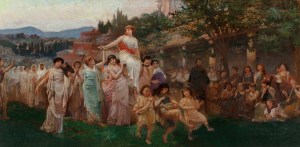
Image Credit: Public Domain – A Roman Wedding Procession by Edwine Howland Blashfield
Roman weddings, like those of the affluent of our day, were elaborate ceremonies with religious rituals. They centered around worshipping Juno, the goddess of marriage. The bride and groom did so in order to receive a blessing from Juno for their marriage. This included sacrifices, prayers, and customs thought to cement the couple’s future and to bring happiness and prosperity.
Let’s look at specific examples.
Choosing the Wedding Date
June was the most popular month for Roman weddings. And Juno had a lot to do with that. Even so, brides and grooms could consider other months as well. But they were always based on lunar cycles.
The Confarreatio Ceremony
The most sacred Roman wedding was called the “confarreatio.” A significant part of this ritual involved the couple sharing a spelt cake (panis farreus). The cake symbolized unity and abundance. It was a solemn pledge to Juno and to each other.
Nuptial Rites and Sacrifices
Before the wedding ceremony, the couple offered cakes, wine, and incense to Juno while the Priests recited prayers. These practices further emphasized Juno’s central role in the wedding ceremony. These offerings were believed to purify and bless the union.
The Bridal Procession
After the ceremony, a procession would lead the bride to her new home, where nuts and coins lined the path. These symbolized fertility and prosperity. As the procession made its way through town, they stopped at shrines and offered prayers to Juno. Further confirming Juno’s protection over the marriage.
The Pronuba
Like the modern-day maid or matron of honor, the “pronuba” was a married woman. The pronuba assisted the bride before, during, and after the wedding ceremony. As a representative of Juno’s, she embodied the ideals of marital fidelity and longevity. Her role was to guide the bride through the wedding rituals. It was no wonder that the pronuba ensured tradition was followed.
Legacy of Time
There is no doubt that the goddess Juno played a pivotal role in ancient wedding ceremonies. It underscored the profound cultural significance and importance of marriage in Roman society. Such customs highlighted how entwined Juno was in the institution of marriage.
Part 3 will explore the transformation from Juno’s central role in the wedding ceremony to the sacred vows before the God of Christianity.