I welcome love that delights in who I am — not who I try to be.
There is a longing deeper than being seen or being pursued. It is the longing to be delighted in. That feeling of bringing someone joy. Or causing someone to smile. Or being the twinkle in someone’s eye.
Delight says, I want to be with you. I want to see you smile. I appreciate you. I enjoy your company. I cherish you.
Think about that.
If you are not sensing these feelings in your relationship, it may be time for an honest talk.
In the Song of Songs, delight is everywhere. It is spoken. It is sung. It is celebrated.
The lovers do not hide their joy in one another. They speak it. They name it. They savor it.
Sacred love invites you into that same truth — that you are not only wanted, not only pursued, but delighted in.
Delight is different from desire. Desire reaches for you. Delight rests in you.
Is your lover resting in you?
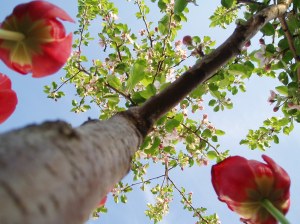
Like an apple tree among the trees of the forest is my beloved among the young men. I delight to sit in his shade, and his fruit is sweet to my taste.
— Song of Solomon 2:3
May you feel the sparkle of being delighted in. May you find joy within you and around you. Amen.
“Tulips & apple tree | Tulipany i jabłonka” by Maciej Szczepaniak is licensed under CC BY 2.0.
I welcome love that sees me and honors me for who I am.
We all have a longing. To be recognized. To be understood. To be cherished.
And yet we often hide the very depths of our souls. Those quiet places. Tender spaces. The place where there is fear.
We fear we are too much. Or not enough. Not worthy. But that couldn’t be further from the truth.
One of my long-time friends once told me he loved my eyes — “exotic, almond‑shaped,” he said. Forty years later, I still remember those words. Why? Because in that moment, I felt noticed. I felt like I mattered. I felt valued.
How often do people notice a small sacred detail about you and then actually speak it?
What kind of world would we live in if we spoke the beauty we see instead of keeping it to ourselves?
How beautiful you are, my darling! Oh, how beautiful! Your eyes behind your veil are doves. Your hair is like a flock of goats descending from the hills of Gilead.
– Song of Solomon 4:1
May you truly experience what it feels like to be seen — not for what you do, but for who you are. May sacred love meet and guide you where you need to be. Amen.
Image Credit: “The Veiled Woman” by Koshyk is licensed under CC BY 2.0.
In our previous two posts, we discussed how faith can help us see life through a different lens. We learned how faith can transform and turn us into new creations by providing the courage to move beyond our past. Then, we explored how we can find peace with ourselves and others by seeking reconnection and reconciliation. Today, we will explore divine intervention and new beginnings.
Divine Intervention and New Beginnings
Peace and reconciliation bring newness to our relationships with God, our families, and our communities. Divine intervention allows us to grow into this new creation, like cranberries and stevia, transforming lemonade into something fresh and different. The key is to be receptive and hear God’s calling. We must allow God to work within us as we feel a nudge to do something different.
How do you see divine intervention in your daily life? What role does prayer play in your life?
Action
This week, consider reaching out to someone you have lost touch with.
Prayer – Let us pray…
Divine Creator, You are in and around me. I surrender my life and all of my relationships to the Universe. Fill me with love. I trust You will direct my path and journey with me. Help me to create something spectacular with lemons!
If you enjoyed this please remember to Share, Like, Follow. (This is my “call to action” I’m supposed to include in every post and often forget. Thanks so much for your support!)
Last time we imagined we were a glass of lemonade. We tried envisioning what we could add to our lives (the lemonade) to make it new and different (cranberries). We learned that faith shapes us and can help us become a new creation.
The Power of Reconciliation
Reconciliation is a natural consequence of personal transformation. We seek to heal past wounds and rebuild broken relationships as we grow in faith. However, reconciliation can be complicated. It takes two willing hearts.
John and Sally
Consider John, who has recently embraced his faith. In his journey of self-discovery, he feels compelled to reach out to his cousin Sally, whom he hasn’t spoken to in over a decade due to an old argument. John is ready to reconcile, but Sally may not be. John’s willingness to reach out is a powerful first step. He has done what he can and now can rest in the knowledge that he has made an effort, continuing to pray and hope for a future reconciliation.
Cranberry Lemonade: A Symbol of Newness
Just as adding cranberry juice to lemonade creates a new and refreshing drink, welcoming the Creator and others into our lives makes us new. Paul’s words echo this truth:
“The old has gone; the new is here!”
This newness isn’t just a surface change—it’s a complete transformation of our spirits, connecting us to the Divine and one another. It’s about embracing a new way of thinking, a new way of living, and a new way of relating to others.
What practical steps can you take today to embrace the newness of realizing you are a faith-based person?
Start by reflecting on your beliefs and values and how they influence your actions. Then, consider how you can align your life more closely with these principles. This could involve regular prayer, attending religious services, or engaging in acts of kindness and compassion.
Finding Peace in Reconciliation
True peace comes when we accept relationships as they are, not as they were or as we wish they might be. In his message, Paul urges us to be reconciled to God. But before we can do this, we must make amends with those around us. Apologizing and seeking forgiveness allows us to find peace within ourselves and the world around us.
In the case of estrangement, I am not advocating writing a letter of amends. However, I am advocating that you write a letter or multiple letters for your eyes only and then place them in a memory box or burn them. Experts have mixed thoughts on this. Remember, both hearts need to be ready. Processing emotions is part of healing, even when reconciliation isn’t possible, yet.
Is there someone with whom you have had a falling out? How might your own transformation inspire you to reach out and seek reconciliation?
Next time, we will conclude this series on Cranberry Lemonade as we explore the topic of faith and new beginnings, where we will explore divine intervention.
If you enjoyed this please remember to Share, Like, Follow. (This is my “call to action” I’m supposed to include in every post and often forget. Thanks so much for your support!)
Intergenerational curses have a profound impact on the family. These cycles, often perpetuated unintentionally, can manifest in various forms. This can include domestic violence – a cycle rooted in power and control. Or addiction. Or incarceration. Or alcoholism. Or mental illness. Or a host of other issues like depression, anger, or anxiety.
A Blessing or a Curse?
Image Source: Clipartkey dot com
What type of family do you have?
Did you grow up feeling loved, wanted, and cared for?
Or did you grow up feeling like a burden? Like your parents were going through the motions but didn’t want you around?
Today, we want to break the chains. We want to embrace love, empathy, and resilience. By understanding and addressing the roots of these challenges, we pave a path to healing. And healing leads to transformation. Which ensures that our legacy is one of strength and compassion. Let’s free ourselves from the shadows of the past.
1 in 4 people are estranged from a family member. 1 in 3 women and 1 in 10 men have experienced domestic violence. 40-50% of marriages end in divorce.
Psychologytoday dot com -National Center for Health Research -American Psychological Association
There is no denying that the family unit has disintegrated over the past several decades. This piece is a call to:
Educate. Create awareness. Take action.
We must confront the intergenerational curses affecting our families head-on. No sidestepping this issue anymore. Because our parents’ choices continue to scar us and future generations. We’ve inherited patterns of abandonment. Lack of belonging. Pain, anxiety, and dysfunction. Including the cycle of sexual, emotional, physical, or financial abuse. These issues must be addressed with honesty and with an open heart.
We must acknowledge that our ancestors were flawed. Which contributed to our parents’ and our own imperfections.
The Inherited Legacy
Our families are like ancient trees with roots deep in tradition. We inherit not only physical traits but also emotional legacies. Perhaps your great-grandfather struggled with addiction. Or your grandmother’s unfulfilled dreams haunted her. These experiences shape how we perceive the world and interact with others. Thus, our childhood experiences have affected every single one of our relationships. Past, present, and future. Unless we break the cycle.
Breaking the Cycle
Recognizing generational curses is the first step to breaking free. It’s not about blame; it’s about understanding. By shedding light on these patterns, we empower ourselves to make different choices.
Actions:Choose forgiveness and open communication. Seek financial literacy and create a new path to end the plague of economic struggles. Read and educate yourself on the cycle of power and control. Learn how behaviors can affirm or minimalize.
Understanding the cycle of domestic violence can stop it in its tracks. Power and control perpetuate abuse across generations. Recognizing this cycle enables us to intervene, break the chain, and offer support. Ask, “Who abused your abuser?” Realizing that your abuser was also most likely abused fosters compassion and understanding.
Hope and Healing
Let’s rise above the issues that threaten the fabric of the family. One step at a time.
American Family Day is on the first Sunday in August. It invites us to rewrite our family narratives.
Actions:Start by replacing curses with blessings. Reach out to an estranged relative, or a relative that harmed you. Listen without judgment, and offer compassion. Seek therapy or counseling if needed.
Healing isn’t linear; it’s a journey of small victories and setbacks. But with each step forward, we honor ourselves and our ancestors. By creating a brighter future.
As we celebrate family today, let’s break the chains of generational curses. Let love, empathy, and resilience be our legacy. One that transcends time and transforms lives.
I love to think of nature as an unlimited broadcasting station, through which God speaks to us every hour, if we will only tune in.
George Washington Carver
Our last post discussed the imperative need to rest and recharge. Today, we will explore the concept of finding rest in nature.
Camping as a Kid
When I was a kid, my family went camping every summer. It was something my dad looked forward to each year. Me, not so much. But, when you are a kid, you learn to grin and bear it.
My dad worked in an environment where noise prevented him from hearing others speak. The air was filled with dust, metal shavings, and oil substances. Gears churned within the walls, and motors whistled, so it was no wonder he wanted to escape to the woods.It was his happy place.
Image Source: publicdomainpictures dot net
As much as I didn’t like camping, I remember nature’s sounds: the potatoes wrapped in foil crackling in the fire, the crickets chirping, and the owls hooting at night. And then the stars. I remember looking up at the vast sky and seeing millions of stars I had never seen before—or perhaps didn’t choose to stop and appreciate at home. One thing I learned while camping was the closeness I felt to God. I saw God everywhere.
Reflect on Your Past
To better understand your relationship with nature, consider the following:
Did your childhood teach you how to connect with nature? Were you able to explore the outdoors on your own or in groups? How did your parents feel about nature?
Action: Spend a few minutes reflecting on your past experiences with nature. Write down one memorable experience and how it made you feel. Use this reflection to connect with your current relationship with the outdoors.
The Gift of Creation
By the seventh day God had finished the work he had been doing; so on the seventh day he rested from all his work. Then God blessed the seventh day and made it holy, because on it he rested from all the work of creating that he had done.
Genesis 2:2-3
Nature reflects God’s beauty and provides a sanctuary for rest. Signs of nature are everywhere, from the tiny tadpoles near a stream to the crabs crawling on a beach. If you choose to notice.
Action:Promise yourself to spend time outdoors. Whether it’s a walk in the park, a hike, or simply sitting on your patio, go be in nature. Quiet yourself as you hear the birds and experience the nature around you. Start with short, mindful moments of rest. Rest for your mental and physical well-being. Gradually increase your time spent outdoors.
Connecting with nature opens up the opportunity to connect with Spirit, which allows you to communicate with the Creator of all nature. In God, rest and rejuvenation are found. Like the woman at the well in the Gospel of John 4:10, God offers each one of us living water. It is this water that brings us eternal rest.
“Come to me, all you who are weary and burdened, and I will give you rest. Take my yoke upon you and learn from me, for I am gentle and humble in heart, and you will find rest for your souls. For my yoke is easy and my burden is light.”
Matthew 11:28-30
Summer is the typical time people take vacation. It is a period designed explicitly for rest and relaxation. In Matthew 11:28-30, Jesus invites the weary and burdened to find rest in Him. By prioritizing self-care, we become refreshed, allowing us to seek God’s peace and restoration.
The daily grind takes a toll on us. The barrage of emails, text messages, and input from outside sources makes us feel like a worn-out sponge. Soaking up the information and then regurgitating it at that moment or another time. Sooner or later, you will dry out and fall apart.
Reflect on Your Past
To better understand your current state of mental health, consider the following:
Did your childhood teach you good self-care? Were you able to speak your mind without retribution? How did your parents take care of themselves?
These questions will reveal your history and your story.
In your story, you can go back and rewrite it. Rewrite the story so you won’t feel guilty when you are not working. Take time to kick up your feet and just relax. Enjoy your family for who they are because you want to, not as an obligation.
Action: Spend 5 minutes thinking about your childhood. Answer one question by writing or typing it out. Build on this each day until you feel you have answered each one adequately.
Verbalize Your Needs
Learning to verbalize your wants and needs is vital for good mental health. It does take practice. So, think about starting this summer! But first, you will need to list what these are. Then, you can reflect upon them. It is essential for good mental health. You can start by asking yourself:
Do I need more alone time or social time? What activities do I like to do alone? What do I want to do with other people? What resources do I need to live a balanced life?
Action: Spend another 5 minutes thinking about your childhood. Write down whether you needed more alone time or social time and list one example to support your answer. Then spend another 5 minutes thinking about the present. Build on this each day until you feel you have answered each one adequately.
Consider Others
When we rest and refresh, we strengthen our relationships with others. Empathy allows us to connect deeply, promoting a sense of community. By understanding and valuing the perspectives of others, we can offer support and kindness in meaningful ways. This balance between self-care and caring for others enriches our lives and helps create a kinder, gentler world.
Imagine the ripple effect: when you take time to care for yourself, you are better equipped to care for those around you. Renewed energy and a positive outlook can inspire others.
Action: Think of one person you can reach out to this week and offer a kind word or run an errand.
The next time you question whether you need to work late, ask yourself, “What would Jesus do?” That should answer your question.
is a time to honor and celebrate the fathers in our lives. While expectations of fathers may have changed over the years, the core values of what makes a good father (or step-father) are timeless.
A good father is more than just a provider; he is a nurturer, a guide, and a pillar of support for his partner, children, and community.
Core Values of a Good Father
Attachment
Attachment theory, developed by psychologist John Bowlby, emphasizes the importance of forming a secure bond between a child and their caregiver. A good father fosters this bond through consistent presence and emotional availability. He helps his children develop a sense of security and trust by providing comfort and support. It starts with taking turns with changing diapers, late-night feedings, and going to bed routines. This secure attachment lays the foundation for healthy emotional development and relationships throughout the child’s life.
Attunement
Attunement refers to a parent’s ability to recognize, understand, and respond appropriately to their child’s emotional states. A good father is attuned to his children’s spoken and unspoken needs. He listens actively, observes carefully, and provides support to help them navigate their feelings. A good father is empathetic and helps his children feel understood and valued, fostering their emotional intelligence and resilience.
Respect
Respect is fundamental to any healthy relationship, and the father-child relationship is no exception. A good father respects his children’s individuality and encourages their autonomy. He acknowledges their unique personalities, interests, and perspectives and supports their independence. By showing respect, he teaches his children to value themselves and others, promoting a healthy sense of self-worth and mutual respect in their interactions.
Personal Growth
A good father is not only a teacher but also a learner. He models personal growth by adapting to his family’s changing needs. Whether deepening emotional intimacy with his spouse, enhancing parenting skills, or working on personal challenges, his commitment to growth inspires his children to pursue their own development paths. This lifelong learning mindset fosters a culture of continuous improvement and resilience within the family.
Prioritizing Children’s Needs
One of the defining qualities of a good father is his ability to prioritize his children’s needs. This does not mean neglecting his own well-being but instead finding a balance where the children’s physical, emotional, and psychological needs are prioritized. A good father understands the importance of providing a safe and nurturing environment, even if it requires personal sacrifices. He makes sure they have the resources and support they need to thrive.
Mental Health
A good father values good mental health. He recognizes the importance of emotional well-being and openly discusses such things. By addressing issues such as respect, value, self-esteem, stress, anxiety, and depression, he helps normalize the conversation. Providing space for emotional expression and seeking professional help promotes a healthy, balanced life.
Respect for the Mother of His Children
A good father shows respect for the mother of his children. He recognizes that a harmonious and respectful relationship sets a positive example for their children. Whether partners or co-parents, mutual respect and cooperation are crucial for creating a stable and loving environment. By treating the mother of his children with kindness, consideration, and respect, he demonstrates the importance of healthy relationships and teamwork. This respect benefits the children by providing a model of positive interaction that strengthens the overall family unit.
The Legacy of a Good Father
Father’s Day is an opportunity to reflect on and appreciate the profound impact that good fathers have on their children’s lives. Good fathers lay a solid foundation. As we celebrate this special day, let us honor the fathers who embody these qualities and strive to be the best role models they can be. Their dedication and love create a lasting legacy for generations to come.
Happy Father’s Day
#Father’sDay #Attachment #Attunement #Respect #Mental Health #RoleModel









 I and Thou Reflections