The Origin of the Strawberry
Introduction
I love Valentine’s Day!
It is one of my favorite holidays. I don’t get suckered into commercialism; I take time to reflect on love. Past. Present. Future.
So, spending the next few posts exploring the connection between Valentine’s Day, love, and strawberries is fitting. Remember that Valentine’s Day is a day to celebrate love. It doesn’t necessarily involve romantic love. Love is love.
Is it a Plant or a Fruit?
Valentine’s Day is a perfect time for indulging in fresh strawberries from the farmer’s market. Their sweet aroma fills the air and dazzles the senses, evoking a smile from ear to ear.
Did you know that this tiny, robust red fruit is not just a fruit but also a plant?
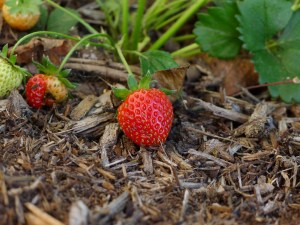
Botanically, the “fruit” of the strawberry is not a fruit at all. The fleshy, edible part of the plant is the enlarged receptacle of the flower. The visible “seeds” that dot the surface of the strawberry actually are achenes. An achene is a type of dry fruit borne by some plants in nature where the ripened ovary contains but a single seed.
David Trinklein, University of Missouri, Plant Science & Technology (2012)
Have you ever grown strawberries? Or observed them growing in a garden or field? These vine-like stems sprawl in all directions and lay low; hence, they are the “strewn” in strawberries.
Where Did They Come From?
By the 1300s, the strawberry was in cultivation in Europe when the French began transplanting the wood strawberry (Fragaria vesca) from the wilderness to the garden. At the end of the 1500s, the musky strawberry (Fragaria moschata) was also cultivated in European gardens. Then, in the 1600s, North America’s Virginia strawberry (Fragaria virginiana) reached Europe. The spread of this new, relatively hardy species was gradual, and it remained little appreciated until the end of the 1700s and early 1800s when it was popular in England. At that time, English gardeners worked to raise new varieties from seed, and they increased the number of varieties from three to nearly thirty.
Vern Grubinger, Vegetable and Berry Specialist, The University of Vermont
Strawberry is a member of the Rosaceae family, and its official name is Fragaria. Strawberries are native to North America. Native Americans used them in many dishes, and the first colonists shipped them back to Europe as early as 16001.
Versatile Little Treasures
Home gardens are an ideal environment for nurturing strawberries. They only require a little space, and they yield a fair amount.
You may want to purchase extra strawberries this week. Or better yet, share a few chocolate-covered strawberries with a special someone. These timeless treasures make the perfect Valentine’s gift.
Happy Valentine’s Week.
#Valentine #Valentine’sDay #Strawberry #Love
 I and Thou Reflections