Image Source: Pinterest – Silhouette by Eva on Indulgy dot com
O Spirt of the Sapphire, In the vastness of the air we breathe, Gentle breezes whisper and wave.
O Spirit of the Sapphire, In the vastness of the sapphire skies, Millions and millions of diamonds glisten and sparkle.
O Spirit of the Sapphire, In the vastness of the Universe, Angels spread their wings and guard the heavens.
Holy Spirit, come to us.
O Spirit of the Sapphire, In the vastness of the luscious landscape, Fruits and vegetables nourish our souls.
O Spirit of the Sapphire, Feed us with the Tree of Life, Where the Garden of Eden lies.
O Spirit of the Sapphire, In the depths of the ocean floor, Millions and millions of hidden treasures wait to be found.
Holy Spirit, come to us.
O Spirit of the Sapphire, In the depths of the earth’s inner molten core, Fire forges rocks and minerals to endure the test of time.
O Spirit of the Sapphire, Up on the mountain tall, The God of Israel shines in glory.
O Spirit of the Sapphire, Take us up to heaven’s gate Where cherubim’s dance and angels sing.
Holy Spirit, come to us.
O Spirit of the Sapphire, Artistically woven into the breastplate, Worn by the twelve tribes of Israel. Where a Sapphire is set in gold On the second row.
O Spirit of the Sapphire, Grant safe passage to the scarlet knight, Precious stones echo in the distance, A song of grace to praise His name.
O Spirit of the Sapphire, Lead us to the narrow path, Where your shining face casts an eternal glow.
Breathe on me, O Lord, Fill me with your divine power. Rain down from the heavens. Your love and grace where mercy abounds.
You shine your mighty light upon the world, To lead the way to heaven above, Where you welcome us with open arms.
All who enter, come sit down, To hear the voice of God. Like a gentle lamb nudging your nose, Arms that comfort and warmly embrace.
Those who follow me hear my voice. They feel the gentle tug. The roaring lion shuts his mouth, When he hears the footsteps of the Savior.
Through the gates of pearls, The streets of sapphire and gold, Lead to a spiritual awakening. Lamb and lion embrace in symbiotic love.
Love pours down from the heavens above, To shower us from the filth of the world. Purity is what God wants, From all who dare to care.
Gems are most precious to God Like you and me and the stars above. Each sapphire casts a healing spell, Of wisdom, grace, and divinity. Gather up the sapphire stones, Hear the whispers of the Spirit.
O Spirit of the Sapphire, In the vastness of the firmament, Protect us from the evil one. Wrap us in your loving arms, To keep us safe from eternal harm.
And perhaps a magical time for a bride and groom to pledge their love to one another amongst family and friends.
In Part 1, we talked about June, which dates back to the Roman Empire and how Juno, the Roman goddess of marriage and childbirth, inspired its popularity among couples wanting to tie the knot.
In this post, we will dig deeper into the role Juno played in the traditional ancient wedding.
Ancient Wedding Traditions
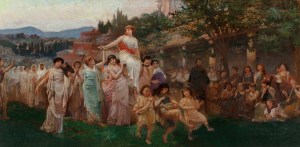
Image Credit: Public Domain – A Roman Wedding Procession by Edwine Howland Blashfield
Roman weddings, like those of the affluent of our day, were elaborate ceremonies with religious rituals. They centered around worshipping Juno, the goddess of marriage. The bride and groom did so in order to receive a blessing from Juno for their marriage. This included sacrifices, prayers, and customs thought to cement the couple’s future and to bring happiness and prosperity.
Let’s look at specific examples.
Choosing the Wedding Date
June was the most popular month for Roman weddings. And Juno had a lot to do with that. Even so, brides and grooms could consider other months as well. But they were always based on lunar cycles.
The Confarreatio Ceremony
The most sacred Roman wedding was called the “confarreatio.” A significant part of this ritual involved the couple sharing a spelt cake (panis farreus). The cake symbolized unity and abundance. It was a solemn pledge to Juno and to each other.
Nuptial Rites and Sacrifices
Before the wedding ceremony, the couple offered cakes, wine, and incense to Juno while the Priests recited prayers. These practices further emphasized Juno’s central role in the wedding ceremony. These offerings were believed to purify and bless the union.
The Bridal Procession
After the ceremony, a procession would lead the bride to her new home, where nuts and coins lined the path. These symbolized fertility and prosperity. As the procession made its way through town, they stopped at shrines and offered prayers to Juno. Further confirming Juno’s protection over the marriage.
The Pronuba
Like the modern-day maid or matron of honor, the “pronuba” was a married woman. The pronuba assisted the bride before, during, and after the wedding ceremony. As a representative of Juno’s, she embodied the ideals of marital fidelity and longevity. Her role was to guide the bride through the wedding rituals. It was no wonder that the pronuba ensured tradition was followed.
Legacy of Time
There is no doubt that the goddess Juno played a pivotal role in ancient wedding ceremonies. It underscored the profound cultural significance and importance of marriage in Roman society. Such customs highlighted how entwined Juno was in the institution of marriage.
Part 3 will explore the transformation from Juno’s central role in the wedding ceremony to the sacred vows before the God of Christianity.
We have been on a quest to find the sacredness in tragedy. A mighty tall order, wouldn’t you say?
In the previous seven posts, we looked at tragic events and took deep dive into the meaning of righteousness and sacredness. Today, we will explore trauma.
The Miracle of Birth
For those of you who have given birth, or witnessed this, it is nothing short of miraculous. The experience of birth is sacred.
Babies
Babies are incredible. They have the tiniest toes and fingers. With bodies that almost fit in the palm of a hand. And eyes that may or may not be open. Yet, in a few days, babies start to gaze into their parent’s eyes with all the love in the world. They are truly a gift from God.
Life-and-death circumstances might make us question God’s omnipotence (the power of God), or God’s goodness. In other words, God’s willingness to prevent terrible things from happening. Such as when a baby is miscarried. Or stillborn. Or born less than perfect.
Parents may wonder “Where was God?”
Or
“Why did this have to happen?”
Surely, God doesn’t create imperfect beings. God can’t take my baby away. Can he?
No Answers, Yet
We simply do not know. Maybe one day we will find out. But for now – for many of us – certainty is elusive.
Some of us may simply choose to trust that God is there. Some may be fortunate enough to feel God’s presence – even in the midst of suffering. While others may feel lost, or alone or even foresaken by God. During times of trial and tribulation we often experience a floodgate of emotions. We may feel that God is nowhere to be found. Yet, could it be that, even then, God is with us – even though we may not see it? Years later when we look back, we may discover that lessons have been learned, inner convinctions formed, and/or meaning found.
The next time you find yourself in the middle of a storm, can you imagine holding out your hand so God can grasp and hold it in his own?
Traumatic Events
Think back on your own life. Do you remember traumatic events from your childhood…or teenage years…or adulthood?
People often think of the big events. Yet seemingly smaller incidents can become a significant source of trauma as well. Like having best friends move away when you were a young child. Or perhaps there were times when you were bullied. Maybe you lost precious possessions such as a piece of jewelry, or had a favorite keepsake stolen from you at school. At the time, perhaps your emotions were strong or clouded your thinking. You might even have thought, “Why did God let this happen to me?”
Over time, however, we can learn from our experiences and reflect upon them. What lessons have we learned from the trauma or tragedy that we experienced? Have we become more compassionate? Have we devoted ourselves to a cause that is close to our hearts? Did you, for example, decide to become a doctor because you were once an accident-prone kid?
It may be that things happen for a reason, which, at first, we may not have understood. Maybe that is where the saying, “Time will tell,” comes from.
A Time for Everything
In life, there is death. Before death is life. Life begins at birth. Could it be that, after death there is eternal life?
There is a time for everything, and a season for every activity under the heavens: a time to be born and a time to die.
Ecclesiastes 3:1,2a
Over the past few weeks, we have explored the question: Can sacredness be found in tragedy? As we move forward in life, may we be open-minded. May we love one another through all the facets of our lives, including the tragedies that come out of nowhere.
Image Credit: “Womb Paradise” by Alex Florschutz from sistersawake dot org
In Part 6, we learned a little about Miss Bella and her infant son who was born with a rare disease. This tragic circumstance was so unepected. No one saw it coming. We continue this story.
It’s Not Fair
After the initial shock wore off, Miss Bella may have thought:
It’s not fair to the baby. It’s not fair to (us) the parents. It’s not fair to (our other child) the sibling. Life expectancy is short with this rare disease.
Why God? Why me?
Miss Bella felt so alone after her baby’s birth. (YouTube Video*)
After all, how would we feel if we were told our baby has a rare disease? Six months later, she put on a courageous face and filmed a YouTube video. Why? Because she didn’t want others to feel alone like her.
The Story of Bella Joy shows how an apparently uneventful pregnancy can yield a calamitous life-changing outcome. Miss Bella navigated through an unexpected situation as best she could. Then, this strong momma shared her experience with the world to give others hope and encouragement. Instead of dwelling on the negative, she found the strength to overcome her circumstances.
And, more importantly, to serve others.
Why is service so important?
Serving others reflects God’s love and fulfills the Biblical commandment that we love one another. If we focus on love and serving others, even in the midst of evil or heartbreak, that is where we find the sacred. It does not nullify – or remove – evil, tragedy, and human suffering. Rather it is precisely here, in the midst of catastrophe, that the sacred becomes manifest. This is where God is present – whether we see and sense him, or not. And this is why, even in the most terrible circumstances, people are able to find hope, offer love, and serve one another.
The next post will explore the cycle of life in the context of there being a time for everything. We will then wrap this series up on finding the sacredness in tragedy.
Today, we will examine the questions we might ask ourselves when tragedy attacks.
In the face of such pain, people find themselves grappling with profound questions such as:
“Where was God?” and “Why did this have to happen?”
Every day, lives and dreams disappear in the twinkling of an eye. In Part 1, we saw how they disappeared the moment the O-rings failed following the launch of the Challenger space shuttle.
Life is truly short.
We turn now to the Old Testament.
The Story of Cain and Abel
Two brothers. One jealous. One not. One life. One death.
In the fourth chapter of Genesis, the first book of the Bible, we learn of the tragic tale of Adam and Eve’s family. They have two sons, Cain and Abel. Then, one day, in a fit of jealousy, Cain kills his brother Abel.
Let’s read a few verses.
In the course of time Cain brought some of the fruits of the soil as an offering to the Lord. And Abel also brought an offering—fat portions from some of the firstborn of his flock. The Lord looked with favor on Abel and his offering, but on Cain and his offering he did not look with favor. So Cain was very angry, and his face was downcast.
Genesis 4:3-5
“Where was God?” and “Why did this have to happen?”
We really don’t know. Cain may have felt God’s absence, which may have fueled the fire. Yet, there is no doubt that Cain was angry. But we don’t know how furious he was or what type of anger management issues he may have had.
Which brings us more questions than answers.
Then the Lord said to Cain, “Where is your brother Abel?” “I don’t know,” he replied. “Am I my brother’s keeper?” The Lord said, “What have you done? Listen! Your brother’s blood cries out to me from the ground.”
Genesis 4:9-10
After God asks Cain what he has done, Cain lies. God banishes Cain from his presence and makes him a wanderer. And that is the end of the story.
So, these questions remain:
Where was God when Cain killed Abel? Why did God let this happen? Where is the sacredness in this story?
Like in all tragedy, God is there. Right? I tend to think, yes. Yet, many people may feel that God is no where to be found during difficult times. This theme will be woven throughout this series. In this Story of Cain and Abel, God was in the midst. Smack in the middle! As we see in the dialogue between God and Cain.
Another compelling question to consider, not listed above, in the Cain and Abel story is: “What made one offering more acceptable to God than the other?” This question might get at the heart of the matter, “Why did God let this happen?” Perhaps God’s favoritism toward Abel was the trigger for his murder.
Favoritism
If you ask siblings if their parents had a favorite, I’m pretty sure most of the time, a sibling would be able to “name” the favorite. It could be the oldest, the youngest, or the one who was the most “obedient” child. But let’s flip this a bit. How would you feel if you weren’t the favorite? Pause and think about it.
Before we leave the hot topic of “favorites,” consider this: How would you feel if God favored someone over you? This situation seems to take it up a notch, doesn’t it? And, in a roundabout way, it brings us back to one of the initial questions.
A Tricky Question
“Why did God let this happen?” A tricky question, for sure. Why does God let any tragedy happen? Cain could have been pissed off at God. He didn’t have to kill his brother, did he? It’s complicated. Clearly, we don’t have all the facts.
In the next few posts, we will continue to search for the sacredness that is either in or emerges from tragedy. Hang in there, dear reader, Part 3 will shed more light. I promise.
Image Credit: Abstract Sunrise Space Wallpaper 1920×1080 (Pixelstalk dot net)
In the next few posts, we will explore the concept of sacredness and how it can be found in the very essence of tragedy. In accidents, calamities, or vicious crimes, we, as people made in the image of God, have the free will to respond in any way we wish. As children of God, however, there is hope in the trials set before us.
“I have told you these things so that in me you may have peace. In this world you will have trouble. But take heart! I have overcome the world.”
Jesus, The Gospel According to John, 16:33
The Challenger
Most of us are familiar with the tragedy of The Challenger. Thousands watched it launch in person that day. And millions more watched it in real-time or on the news after the fact. Seventy-three seconds after lift-off, plumes of smoke spiraled downward from the sky.
It was a chilly day in January 1986 in Cape Canaveral, FL. It was so cold that frost covered the aircraft. One of the reasons that the space shuttles launch in Florida and Texas is their warm weather patterns. But in January 1986, Florida had an unusual cold snap. The weather had broken all previous records for low temperatures.
One might ask, why would temperature be so important? Well, it had to do with the 0-rings. Or, more generally, its nuts and bolts. The 0-rings had a specific temperature range for optimal success. Cold temperatures would cause the metal to respond more slowly. Or fail, as it did for The Challenger.
Lives and Dreams
Each of the seven crew members lost their life that day. It was a tremendous loss.
Let’s take a moment of silence to honor these brave souls.
Michael J. Smith, Francis R. “Dick” Scobee, Ronald E. McNair, Ellison S. Onizuka, S. Christa McAuliffe, Gregory B. Jarvis, Judith A. Resnik
Mike, Dick, Ron, Ellison, Christa, Greg, and Judy were mothers, fathers, brothers, sisters, aunts and uncles, cousins, and friends. And now they are gone.
Not one person would argue that they left this earth too soon, leaving their loved ones to grieve this unimaginable loss. Each of these individuals was living their dream—the dream of space travel.
Lives and dreams forever lost.
Have you lost special people in your life? Or dreams that can no longer be realized?
Next time, we will explore the questions of “Where was God?” and “Why did this have to happen?” “This” can be applied to many situations and circumstances. Stay with me, and you’ll see how God can transform tragedies into hope.






 I and Thou Reflections