What Christmas has revealed to me this year, is that we can’t ACCEPT the wonder and the awe of the holiness of God UNTIL we PREPARE ourselves to meet the glorious king.
THEN, once we have PREPARED, We will rest in God’s loving arms. And WAIT.
We have a CHOICE.
We can be like the WISE women with the oil lamps or the foolish ones who are not prepared. (Matthew 25)
May the One who sent a babe into the world lead us back to love.
May the PEACE of CHRIST in CHRISTMAS bring you peace today and every day until the end of time.
If you need support from either a no contact or a low contact estrangement today, visit thepaisleyfrog.com for more information about the “8 stages” and you can read about the process of estrangement.
In the meantime, be with those who want you in their lives. And may the peace of Christmas get you through today.
WISHING YOU ALL A boatload OF JOY AND PEACE THIS CHRISTMAS.
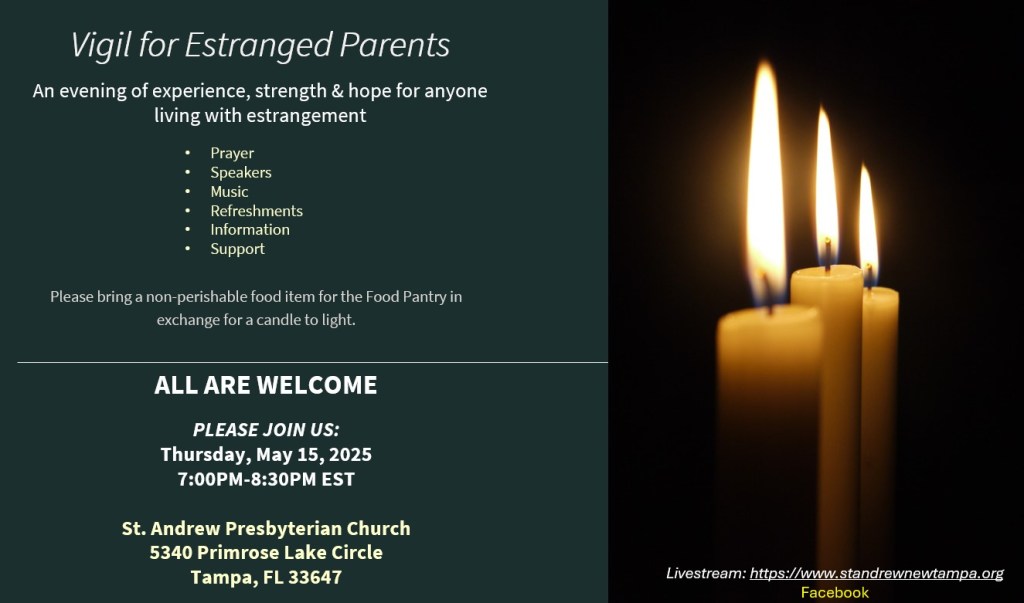
This event will be live-streamed for those who are unable to attend in-person. If attending in-person, SpringHill Suites Hotel on Primrose Lake Circle, Tampa is within walking distance. Here is the link to register:
Last time we imagined we were a glass of lemonade. We tried envisioning what we could add to our lives (the lemonade) to make it new and different (cranberries). We learned that faith shapes us and can help us become a new creation.
The Power of Reconciliation
Reconciliation is a natural consequence of personal transformation. We seek to heal past wounds and rebuild broken relationships as we grow in faith. However, reconciliation can be complicated. It takes two willing hearts.
John and Sally
Consider John, who has recently embraced his faith. In his journey of self-discovery, he feels compelled to reach out to his cousin Sally, whom he hasn’t spoken to in over a decade due to an old argument. John is ready to reconcile, but Sally may not be. John’s willingness to reach out is a powerful first step. He has done what he can and now can rest in the knowledge that he has made an effort, continuing to pray and hope for a future reconciliation.
Cranberry Lemonade: A Symbol of Newness
Just as adding cranberry juice to lemonade creates a new and refreshing drink, welcoming the Creator and others into our lives makes us new. Paul’s words echo this truth:
“The old has gone; the new is here!”
This newness isn’t just a surface change—it’s a complete transformation of our spirits, connecting us to the Divine and one another. It’s about embracing a new way of thinking, a new way of living, and a new way of relating to others.
What practical steps can you take today to embrace the newness of realizing you are a faith-based person?
Start by reflecting on your beliefs and values and how they influence your actions. Then, consider how you can align your life more closely with these principles. This could involve regular prayer, attending religious services, or engaging in acts of kindness and compassion.
Finding Peace in Reconciliation
True peace comes when we accept relationships as they are, not as they were or as we wish they might be. In his message, Paul urges us to be reconciled to God. But before we can do this, we must make amends with those around us. Apologizing and seeking forgiveness allows us to find peace within ourselves and the world around us.
In the case of estrangement, I am not advocating writing a letter of amends. However, I am advocating that you write a letter or multiple letters for your eyes only and then place them in a memory box or burn them. Experts have mixed thoughts on this. Remember, both hearts need to be ready. Processing emotions is part of healing, even when reconciliation isn’t possible, yet.
Is there someone with whom you have had a falling out? How might your own transformation inspire you to reach out and seek reconciliation?
Next time, we will conclude this series on Cranberry Lemonade as we explore the topic of faith and new beginnings, where we will explore divine intervention.
If you enjoyed this please remember to Share, Like, Follow. (This is my “call to action” I’m supposed to include in every post and often forget. Thanks so much for your support!)
Intergenerational curses have a profound impact on the family. These cycles, often perpetuated unintentionally, can manifest in various forms. This can include domestic violence – a cycle rooted in power and control. Or addiction. Or incarceration. Or alcoholism. Or mental illness. Or a host of other issues like depression, anger, or anxiety.
A Blessing or a Curse?
Image Source: Clipartkey dot com
What type of family do you have?
Did you grow up feeling loved, wanted, and cared for?
Or did you grow up feeling like a burden? Like your parents were going through the motions but didn’t want you around?
Today, we want to break the chains. We want to embrace love, empathy, and resilience. By understanding and addressing the roots of these challenges, we pave a path to healing. And healing leads to transformation. Which ensures that our legacy is one of strength and compassion. Let’s free ourselves from the shadows of the past.
1 in 4 people are estranged from a family member. 1 in 3 women and 1 in 10 men have experienced domestic violence. 40-50% of marriages end in divorce.
Psychologytoday dot com -National Center for Health Research -American Psychological Association
There is no denying that the family unit has disintegrated over the past several decades. This piece is a call to:
Educate. Create awareness. Take action.
We must confront the intergenerational curses affecting our families head-on. No sidestepping this issue anymore. Because our parents’ choices continue to scar us and future generations. We’ve inherited patterns of abandonment. Lack of belonging. Pain, anxiety, and dysfunction. Including the cycle of sexual, emotional, physical, or financial abuse. These issues must be addressed with honesty and with an open heart.
We must acknowledge that our ancestors were flawed. Which contributed to our parents’ and our own imperfections.
The Inherited Legacy
Our families are like ancient trees with roots deep in tradition. We inherit not only physical traits but also emotional legacies. Perhaps your great-grandfather struggled with addiction. Or your grandmother’s unfulfilled dreams haunted her. These experiences shape how we perceive the world and interact with others. Thus, our childhood experiences have affected every single one of our relationships. Past, present, and future. Unless we break the cycle.
Breaking the Cycle
Recognizing generational curses is the first step to breaking free. It’s not about blame; it’s about understanding. By shedding light on these patterns, we empower ourselves to make different choices.
Actions:Choose forgiveness and open communication. Seek financial literacy and create a new path to end the plague of economic struggles. Read and educate yourself on the cycle of power and control. Learn how behaviors can affirm or minimalize.
Understanding the cycle of domestic violence can stop it in its tracks. Power and control perpetuate abuse across generations. Recognizing this cycle enables us to intervene, break the chain, and offer support. Ask, “Who abused your abuser?” Realizing that your abuser was also most likely abused fosters compassion and understanding.
Hope and Healing
Let’s rise above the issues that threaten the fabric of the family. One step at a time.
American Family Day is on the first Sunday in August. It invites us to rewrite our family narratives.
Actions:Start by replacing curses with blessings. Reach out to an estranged relative, or a relative that harmed you. Listen without judgment, and offer compassion. Seek therapy or counseling if needed.
Healing isn’t linear; it’s a journey of small victories and setbacks. But with each step forward, we honor ourselves and our ancestors. By creating a brighter future.
As we celebrate family today, let’s break the chains of generational curses. Let love, empathy, and resilience be our legacy. One that transcends time and transforms lives.
Isn’t it interesting that pillows and mattresses come with a tag that states, “Do not remove under penalty of law?” What if each of us were tagged from birth with a “Do not remove under penalty of law?”
The metaphor of the pillow tag represents the bond between family members and the weightiness of breaking it.
Why would some parents remove the tag and others keep the tag on forever? Why would siblings rip the tag off from their brother or sister? Or mother or father? Or child?
Some families abide by the pillow law, while others break it. The difference between them is how they treat each other and how they affect one’s well-being. And this can be intentional or unintentional. And thus, the spider’s web gets more intertwined within itself.
Families who abide by the pillow law are those families who are trying with all their might to keep their family intact.
Healthy families: Provide emotional support. Come together in a crisis. Help solve problems. Speak to one another after a divorce. Provide financial support when needed, if able. Are there for you when you are down. Intervene on your behalf. Stick to you like glue.
Bravo to the pillow law families!
But not all families are like that. Some families break the pillow tag law.
Families that are incomplete.
Not whole. Not healthy. Or just not the family you thought you would have.
A family that is dysfunctional. Abusive. Toxic. Narcissistic. Inability to set boundaries. Abandoned. Alienated. Discarded. Like trash.
Each family dynamic is unique; not all relationships can or should progress. Distancing yourself from toxic or harmful family members can be helpful at times. It can lead to personal growth, healing, and developing healthier relationships. Prioritizing your well-being and safety is crucial. And seeking professional guidance, such as therapy or counseling, can be transformative. Use all the tools available to make informed decisions about family reconciliation.
It’s vital to understand that not all family relationships are salvageable. In some cases, reconciliation may have negative consequences. If the family members have not sought counseling or had profound introspective work done, mending the fences may not be possible. If the parties experienced abuse, addiction, substance abuse, or felt harmed, it may be futile to pursue reconciliation.
It takes two to tango. You both have to be willing partners.
You can repair the pillow tag!
It won’t be perfect like before, but you can mend it. And it could be better than new!
What would reconnection look like in your family?
A divorced family on speaking terms?
A reunification from an estrangement?
Healing from parent alienation?
Family therapy to work out intergenerational trauma?
These are possible ways to mend a broken family and restore the pillow tag. And remember to seek reconciliation with boundaries and professional support.
Follow a new path back to an old family that has changed as much as you have.
Explore. Set an adventure. Change. Restore. Reconnect.
To peace.
To joy.
To love.
To wholeness.
To the tag, “Do not remove under penalty of law.”
If you enjoyed this please remember to Share, Like, Follow. (This is my “call to action” I’m supposed to include in every post and often forget. Thanks so much for your support!)
Princess Diana stood up for what she believed in. She used her voice to challenge the royal system and did things differently. Boy, did Diana do things differently. From breaking from the 1662 tradition of wedding vows, sending her boys to preschool, and wearing black at non-funeral events, she was a rebel in her own right.
Her subtle insistence. Her impish grin. Her brilliant mind. Princess Diana stood up for what she believed in and used her voice to advocate change. Once she realized she had a platform with the public, she wittingly raised awareness of taboo subjects such as HIV/AIDS, mental health, and banning landmines.
Princess Diana stood up for what she believed in by being a hands-on parent to her children. She went to great lengths to provide her children with “normal” kid things such as a Disney vacation, a McDonald’s happy meal, and participating in school events, such as the annual parent’s race, where Diana came in first place in 1988.** She broke royal protocol by being herself – a down-to-earth, fun-loving, jest-for-life person.
Marriage. Parenting. Divorce. Princess Diana stood up for what she believed in and lived a life where she instilled values of honesty, compassion, and kindness. She believed in fairness by fighting for a fair divorce settlement, including shared custody of her children. Diana worked tirelessly to provide a smooth transition for her children to limit the emotional damage divorce does to children. Above all else, she loved her children. She believed in them.
In reflecting on my life, standing up for what I believe in seemed to be a challenge for me. Most likely, stemming from childhood trauma. From that time forward, I felt that I had no voice. It took decades to realize these traumas impacted my relationships far more significantly than I realized then. First marriage. Parenting. Divorce. In my first marriage, I was viewing life through a particular lens. A lens that was colored. Dark. Unfocused. Unable to see the murkiness. Until one day. One day, it all came into focus. It was the day my then-husband did the unspeakable. All in a flash, I saw the truth. And pain.
I was willing to do the hard work, like Princess Diana, of speaking my truth, which enabled me to leave a broken marriage, better myself as a mother, and remarry and become the wife I was meant to be. Standing up for myself has allowed me to be free. Free from harsh words. Free from unkindness. Free from disrespect.
Like Diana, I, too, was a supportive mom to my sons in their growing-up years. I have been and always will be their best cheerleader. Princess Diana inspired millions of people around the world. I have inspired a few here and there too. Diana gradually realized she had a platform to use her voice over time as she gained more confidence as a royal. She also was “just a mom.” She used her voice to speak out against injustice and advocate change. Change in what vows are read at weddings, how we can parent and fulfill career responsibilities at the same time, and why it is necessary to have good mental health.
I am trying to be more like Diana. I speak about estrangement. It is an injustice. I want to bring awareness of how estrangement rips families apart. The other day, a Rabbi called it “psychological murder.” Although it seems harsh, I couldn’t agree more. Knowing your child lives somewhere but not exactly sure where, not having a way to tell whether he reads texts or emails, is like a slow death. Over and over. Each time the phone rings. Each time email is checked. Each time mail is retrieved from the mailbox. Will I ever hear from my son? Parents must be held accountable for alienating themselves, their children, their parents, and extended family members from others including, the other “targeted” parent. The court system must be held accountable for perpetuating broken relationships. Let’s fix it. Together. Together is better.
If you liked this writing, please Share, Like, Follow. Thanks for taking the time to read this post.
Reflections, Poems, & Prayers on ESTRANGEMENT by Nadia Crane has recently been released. This book describes the 8 Stages of Estrangement and more. The author does a great job of simplifying the painful process of estrangement. Ms. Crane offers inspirational reflections, prayers, and poems after the reader becomes intimately personal with the topic. She then goes on to provide a crash course in it with, Estrangement 101.
This book outlines the 8 Stages of Estrangement, as Elizabeth Kubler-Ross describes the grief process related to death in her well-known 5 Stages of Grief. Grief and estrangement overlap in three of the five stages of grief. They are denial, anger, and acceptance. In Ms. Crane’s analysis, her 8 stages add another layer of acceptance, and includes rejection, shame and blame, fear, and healing.
Let’s bring more awareness of this ever-growing epidemic of broken relationships to the masses. If you know a parent who has been shunned, abandoned, blocked or has had no contact with their child, please bring this resource to their attention. If you know someone who is not speaking to their parent for other than abusive, addictive, or other harmful behaviors, please encourage them to reach out to their parent. A parent and child can reconnect with deep compassion, respect, and understanding. Order today and take the first step toward a deeper understanding of this exploding topic.
The 8 Stages of Estrangement Looking at Both Sides of the Coin
From the Parent’s Perspective
Stage 4 | Shame & Blame
Shame typically begins during the rejection phase after a parent has worked through Acceptance Part 1. The reality of the estrangement starts to set in. The questioning begins. A parent may think they lack parenting skills. What on earth did a parent do for a child to shut a parent out completely? Or, what did a parent not do? This stage is when a parent internalizes the pain and questions the validity of the source. Frequently, a parent does not know the reason(s) for the estrangement. A parent begins to feel shame. The shame of a child’s rejection and the shame of what behavior a parent may have or may not have done or said or not said. The mere thought of a child rejecting a parent is vile; therefore, a parent experiences shame. A deep to-the-core type of shame.
I rack my brain day and night trying to figure out where I went wrong. I thought I was encouraging and supportive. I had heart-to-heart conversations with my child when he was young. As he aged, he started to distant himself from me. I thought it was a normal part of growing up. The shame and blame messages played again and again every day and every night. Many nights I cried myself to sleep. When will this nightmare end?
A parent’s perspective
Shame and blame often coincide. A parent blames themself. A parent blames the child. A parent blames the spouse (or former spouse). Or, in the case of parent alienation, blames the court system. In the end, the question remains, was the estrangement caused by another human being? Or was the estrangement caused by an action? A miscommunication? A series of misfortunate incidents? Lack of communication? Or no communication at all? There is blame, shame, and anger all around.
Abstract painting by K. Davies [KevinDaviesART]
From a Child’s Perspective
Stage 4 | Acceptance Part 1
The child comes to terms with the fact they can no longer reach out to the parent under any circumstances. This is when the child begins to accept that they are not speaking to a parent. They have distanced them from the parent and continue not responding to attempts at contact. They have made a choice, and nothing will set them off course. They see this conflict or relationship avoidance as black and white. There is no in-between thinking for the child.
I chose to dissolve this relationship because it wasn’t working. My whole life was turned upside down and I don’t need my mother causing any more drama. It was all about her. She would instigate fights with my father, and I got caught in the middle – all the time. I’m done. No more drama. My father and I have gotten much closer since we are on the same team. We won. My mother lost.
A child’s perspective
At this point, the child is telling themselves they no longer have the parent they have estranged from. They have cut them out of their life. The pain they feel is pushed deep inside and locked in a vault. This stage is when the child feels proud of themselves – that they actually have separated from the parent. The parent who is the perceived enemy is no longer valued, recognized, or seen as a threat. As far as the child is concerned, the parent no longer exists. The child has accepted this course of action and is determined to live their life without their parent in it.
Author’s Note: Estrangement caused me to feel unloved, and I knew I needed to love myself before I could love others again. From my experience in participating in support groups with other estranged parents, there is a choice to make. You can choose to blame, distrust, and be bitter. Or, you can choose to love and heal yourself, from this incredibly harrowing experience, by opening up to others. It’s up to you. A special thank you to Kathryn Kollowa, EdD, MSN, RN for her feedback and added insights incorporated in this most recent update.
If you gained insight into estrangement, please like and comment. (This is my “call to action” I’m supposed to include in every post and often forget.)
The 8 Stages of Estrangement Looking at Both Sides of a Coin
From a Parent’s Perspective
Stage 3 | Rejection
Rejection is an emptiness and a feeling of loss that causes physical and emotional stress. The rejection of a parent by a child is a traumatic experience. It is very much related to power and control. A child has exerted influence and control over the relationship by walking away from it, which is hurtful. Reactions such as anxiety, panic attacks, and other physical pain or stress occur when rejection occurs. If estrangement happens during a divorce, a rejection by a child can add fuel to the fire of feeling rejected by the spouse. Sometimes, an entire set of relatives and friends disappear in what may seem like an instant. During this stage, a parent feels physically and emotionally depleted. Lost. Loss of a child. Loss of a marriage. Loss of a family. Loss of what was. Loss of what was to be
I feel rejected by my son because he doesn’t even acknowledge me. He walks right past me with his head down. I hate seeing my son in so much pain. It makes me sick to my stomach. And I have so much pain too. The pain of rejection runs so deep.
A parent’s perspective
Artist Credit: Vivien Szaniszló
From a Child’s Perspective
Stage 3 | Anger
Remember that these stages ebb and flow, and each person will experience them differently. Certainly, most will travel in and between stages simultaneously as well as distinctly from each other. In this Anger stage, children want nothing to do with their parents. They are angry. They are mad about something and might not even know what makes them angry. It could be a misunderstanding. It could have nothing to do with the parent. It may be from social media. Whatever it is, the child feels anger, spewing it out on their parent or further harming themselves by bottling their anger within or maybe a little of both.
The adult child may resent that their parent(s) didn’t see their distress. They felt unheard. The anger might stem from their birth order, political differences, or something else. They view their parent(s) as toxic. In their perspective, they see their parent as a stumbling block to their own mental health. It is easier for them to break off and cut the opposition out of their lives. The child does not see a way back at this stage. It is not in the realm of their consciousness.
I don’t know why I am so angry. I don’t know what my triggers are. My anger comes from nowhere, and I don’t know how to tame it. I lash out at my parents, and they just don’t understand. I don’t understand, either. My parents are know-it-alls, and that fuels my anger too.
A child’s perspective
Author’s Note: Estrangement caused me to feel unloved, and I knew I needed to love myself before I could love others again. From my experience in participating in support groups with other estranged parents, there is a choice to make. You can choose to blame, distrust, and be bitter. Or, you can choose to love and heal yourself, from this incredibly harrowing experience, by opening up to others. It’s up to you. A special thank you to Kathryn Kollowa, EdD, MSN, RN for her feedback and added insights incorporated in this most recent update.
The 8 Stages of Estrangement Looking at Both Sides of a Coin
From a Parent’s Perspective
Stage 2 | Acceptance Part 1
Once the denial phase is over, a parent begins to accept the concept of estrangement. A parent first seeks to understand the growing number of estranged parent-child relationships by scouring the internet for possible resources. A parent may not even know how commonplace it is and can quickly become an expert on the topic realizing other parents have encountered a similar situation. In this Acceptance Part 1 step, a parent acknowledges that the parent-child relationship has changed. Often, family and friends ask why did this happen? Or, what caused this estrangement?
I’m starting to realize that my child is not speaking to me. At all. He won’t even look at me from afar. What have I done to deserve this punishment? I take a deep breath and I start to believe that my child has deliberately estranged from me. I don’t know why. But I have to come to terms with it. I am so sad for my child that they think this is the only course of action. What makes them so afraid of me that they can’t even talk to me?
A parent’s perspective
This stage is confusing for all parties because the estranged parent is just starting to come to terms with the reality of the lost relationship. Parents need clarification. They don’t know the answers. And these questions may very well trigger sadness. Anger. Emotions come out of nowhere. Accepting the estrangement, even on a superficial level, exposes it, which leads to feeling very vulnerable. Daily living becomes muddled. Parents feel a sense of imbalance and try to come to face the loss. This can invoke feelings of worthlessness.
It is best to support parents going through this experience at this stage. Sit with them. Hold their hand. Give them a hug. Silence may be golden. At this point, reconnection can become an obsession. A parent attempts to discover the reasons for the estrangement and remains hopeful for reconciliation. During this stage, a parent realizes that the relationship that once was is no longer. Coming to terms with this acceptance leads to rejection. Furthermore, feeling both accepting of the situation and rejection by it simultaneously is quite common.
The ghost of a loved one by Chirila Corina fineart.com
From a Child’s Perspective
Stage 2 | Rejection
Children reject a parent. Maybe both parents. This is the stage where a child shuts down. They are rejecting life as they know it. Whether it is from a misperceived conversation, different ideologies, divorce, or a loss of a parent. They want to be alone. They retreat. They start having trouble focusing on work or school. They really want to be somewhere else. They feel trapped because there may be no other place to turn. Children at this stage may look forward to becoming more independent, so they can further reject their current situation.
To put it simply: the emotional exhaustion of trying to reason with someone who isn’t existing on the same page as I am. Trying to reason or share or grow with someone who cannot or will not see outside of their own perspective is like hitting yourself in the head with a hammer over and over; you know it isn’t good, but you feel stuck. Until you get tired of being stuck. You begin to reject the relationship because it is too much of an emotional drain.
A child’s perspective
At this stage, a child may be influenced by the other parent, a peer, their spouse, or another significant person. The third-party encourages the estrangement. The person who is doing the estranging feels guilty. At the same time, they feel rejected. In other words, they feel abandoned by the parent; therefore, they are leaving the parent. Most children do not verbalize these feelings, so it catches the parent off-guard. The child may have been thinking about estrangement for many years. It gradually does become a reality.
Author’s Note: Estrangement caused me to feel unloved, and I knew I needed to love myself before I could love others again. From my experience in participating in support groups with other estranged parents, there is a choice to make. You can choose to blame, distrust, and be bitter. Or, you can choose to love and heal yourself, from this incredibly harrowing experience, by opening up to others. It’s up to you. A special thank you to Kathryn Kollowa, EdD, MSN, RN for her feedback and added insights incorporated in this most recent update.
If you enjoyed this please remember to Share, Like, Follow. (This is my “call to action” I’m supposed to include in every post and often forget.)






 I and Thou Reflections