A Thanksgiving Mindset – Part 2

Last weekend, I dragged my husband to the Arts and Crafts Festival to a section of Tampa called Temple Terrace. The closest parking was about a half mile from the event. When we walked through a parking area into the park, a regal-looking historic building sat majestically on a bed of lush green grass.

Artist Credit: Chrysalis by Patricia Allingham Carlson
fine america dot com

Built in 1914 as a horse stable, The Woodmont Clubhouse is the oldest structure in Temple Terrace. It served as a schoolhouse and is now the home of the Woman’s Club and a venue for special events.

As I squinted at the building, I marveled at its timeless beauty and rich history. I found myself lost in thoughts of transformation. The transformation of a horse stable to a schoolhouse. And, then, to a venue for special occasions.

I thought of resilience and evolution. This brought me back to the theme of transformation. Which, of course, means personal growth for me. I pondered how we could convert this sense of transformation into a Thanksgiving mindset?

Timeless beauty.
Architectural grandeur.
Serene and tranquil.
A treasure trove of memories.
Harmonious and picturesque.

It is simple:
Transformation and Introspection.

You can’t have one without the other.

Let’s begin with Introspection.

“It isn’t enough to talk about peace. One must believe in it. And it isn’t enough to believe in it. One must work at it. It’s not enough to dream of it. It’s not even enough to pray for it.
You must work at it.”

Eleanor Roosevelt

Introspection requires:

  • Developing a Gratitude Attitude
  • Improving Self through Assessment Tools
  • Understanding Healthy Dynamics of Relationships
  • Practicing Mindfulness
  • Respecting Cultural and Spiritual Interpretations

Introspection demands a heart of gratitude to understand the emotions and attachments we have with things. Embracing ourselves as unique sons and daughters of the Almighty Designer of the Universe initiates this journey.

You must work at it!

Self-improvement involves learning lessons, identifying areas for growth, and recognizing strengths through self-assessment tools.

You must work at it!

Strengthening our relationships with others involves observing and learning from them.

You must work at it!

By examining our origins, family system, and individual experiences, we can better recognize triggers so we can redirect ourselves in a healthier way. Digging deep into childhood and unpacking past trauma takes work! It is not for the faint of heart.

You must work at it!

Mindfulness, a multifaceted practice, involves grounding ourselves in the present, examining the past through a magnifying glass with a different lens, creating space to dream, and setting goals for personal growth.

You must work at it!

By fostering a Thanksgiving mindset of introspection, we can truly celebrate beyond material abundance to a godly abundance within ourselves and share joy with those we cherish.

We’ll explore Transformation next time.

Mild Moses Takes the Lead! – Lessons Learned from the Wandering Israelites

Reading how God uses weather to serve purposes for the greater good is fascinating. Today, we will look at the Israelites wandering in the desert.

A Pillar of Cloud.

By day the Lord went ahead of them in a pillar of cloud to guide them on their way and by night in a pillar of fire to give them light, so that they could travel by day or night.

Exodus 13:21

God’s Navigational System.

After the 10 plagues in Egypt, the Israelites began their 40-year trek in the wilderness. At first, they were afraid. They didn’t know where to go. They cried out to God. God sent a cloud by day and fire by night to lead them. Of course, they thought it would take less than forty years. They probably thought it would take only a few months. Can you imagine traveling as a “people” with thousands of mothers, fathers, sisters, and brothers?

The Building of a Leader.

At first, Moses did not think he was capable of leading anyone. He told God that he was slow in speech and tongue. (Exodus 4:10) God wanted to use Moses because of Moses’ humility and willingness to follow God’s direction. God rarely uses the eloquent, strong person to accomplish his mission. He chooses the most unlikely people who turn around and become strong, vibrant leaders.

A Resilient People.

Image Credit: Dorling Kindersley Print
fine art storehouse dot com

Moses spent years honing his leadership skills in managing this great exodus. He learned patience, delegation, and conflict management. His vision and direction created a resilient people. After Moses passed away, God called Joshua to bring the Israelites to Caanan.

Lessons Learned

#1. Strength Comes from Unity and Community.
#2. Wisdom and Inspiration can be found in Family Connections.
#3. Obstacles Prepare Us for Our Life Journey.

Together is Better

In a world where we may feel alone, we can find others who identify with us and can help us overcome challenges. We can achieve goals by leaning on each other for encouragement and support. Can you think of a time when you were discouraged and wanted to quit, yet a friend or loved one encouraged you to continue? What was the outcome?

Gene Pool

Do you have a hankering for salt air? Or you like the cold when it nips your nose. The geographical location of your family of origin might shed some light on some of these quirky feelings you have had all your life.

Family stories provide us with a rich history of what our ancestor’s life journeys may have been like. These stories teach us values. And values can be strengthened by a greater sense of identity and connection to your heritage. Were your family members born during a time of conflict? A time of peace? Did they travel to another place? Was there a failed business? A successful business? Did any of your family members possess a specific talent or skill?

Twists and Turns.

Life is full of unexpected twists and turns. Many of which require hard work. Completing a high school education, college degree, or a trade certification. Or saving for a down payment on a home. What lessons can we learn from the path that leads to our “promised land?”

Maybe the next time you think something is taking “forever” – think again! Let us remember the story of Moses and the wandering Israelites. How steadfast a people continue to flourish despite all odds.

Track down your family tree.

Explore birthplaces.

Be thankful for family.

Take a Deep Breath.

Let’s breathe in wisdom and inspiration and exhale disbelief and pride.

If you liked this topic, please like, because it does matter.
A follow and a comment is great for analytics too!
(This is my “call to action” I’m supposed to include in every post and often forget.)

Fish Guts? No Thanks! – Lessons Learned from the Story of Jonah

Great Wind. Violent Storm.

Then the Lord sent a great wind on the sea, and such a violent storm arose that the ship threatened to break up. All the sailors were afraid, and each cried out to his own god. And they threw the cargo into the sea to lighten the ship.

Jonah 1:4,5

Returning to the series on weather in the bible, we come to the Story of Jonah. In this Old Testament book, God uses a storm to convince Jonah to stop running away from what he needed to do.

Wicked Nineveh.

Let’s not get ahead of ourselves too much. In this story, God calls Jonah to go to Nineveh. Nineveh was a wicked town. Jonah didn’t think he was up to the task, so he jumped onto a ship traveling in the opposite direction. He thought he could outrun and outsmart God.

Threat. Confession.

Artist Credit: Amir Simon Rom On Etsy dot com

Then there was this storm that came out of the blue. It was so severe it threatened the safety of the ships’ crew, and they drew lots to see who was responsible. It pointed to Jonah, who was then forced to confess his disobedience to God.

3 Days & 3 Nights

A great fish, perhaps a whale, swallowed Jonah after the crew threw him overboard into the violent sea. Jonah had plenty of time to think about God while he was in the belly of the fish. Three days and three nights. Jonah finally prayed to God, and the fish spit him out.

Lessons Learned

#1. The Importance of Second Chances.
#2. Sometimes, We Need to Run Away in Order to See Things Differently
#3. You Can’t Outsmart God.

The story of Jonah teaches us some important lessons about obedience, forgiveness, and second chances. It reminds us that it’s essential to listen to God and do what He asks of us, even if it’s difficult or uncomfortable. It also shows us that God is merciful and forgiving, always ready to give us another chance when we mess up. And finally, it reminds us that no matter how far we may have strayed from the right path, it’s never too late to turn back to God and seek His forgiveness.

The next we hear God’s calling, and we don’t want to do what’s right, remember the Story of Jonah.

Follow God’s instructions even if we think we are not up to the task.
Be patient and compassionate as God was with Jonah.
Trust God to guide us back to where we need to be.

These lessons encourage us to reflect on our lives and consider our relationship with God.

Are you good?

Take a deep breath in. Exhale slowly.

Let’s inhale willingness to follow God and exhale our selfishness.

If you liked this post, please like, follow, and comment.

I Feel The Earth Move Under My Feet – Lessons Learned from The Story of Deborah

Earth Shook. Heavens Poured.

When you, Lord, went out from Seir, when you marched from the land of Edom, the earth shook, the heavens poured, the clouds poured down water. The mountains quaked before the Lord, the One of Sinai, before the Lord, the God of Israel.

Judges 5:4-5

Deborah, a prophetess, and a judge led Israel to victory over their enemies. She lived in a time when Israel felt oppressed by the Canaanites, who had 900 iron chariots and a cruel king named Jabin. The Israelites cried out to the Lord for help, and he answered them through Deborah.

10,000 Men.

Deborah summoned Barak, a military leader, and told him to gather 10,000 men from two tribes of Israel. Then, instructed them to go to Mount Tabor. There, the Lord would deliver Jabin’s army into their hands. Barak agreed, but only on one condition: Deborah had to go with him. Deborah accepted but warned him that the honor of defeating Jabin’s general, Sisera, would go to a woman.

Milk. Tent Peg.

The Lord panicked Sisera and his chariots, and they fled before Barak’s army. Sisera abandoned his chariot and ran on foot to the tent of Jael, a woman who was friendly with Jabin. Jael welcomed him into her tent, gave him milk, and covered him with a blanket. Sisera, exhausted from the heat and the fight, fell asleep. Then Jael took a tent peg and a hammer and drove the peg through his temple, killing him.

Deborah’s prophecy was fulfilled: a woman had killed Sisera. Deborah and Barak sang a song of praise to the Lord for giving them victory over their enemies. The land had peace for 40 years.

Lessons Learned

As the Dog Days of Summer officially end, let us learn lessons from Deborah’s story and how it applies to our lives.

1. Don’t Be Afraid to Take Action.
#2. Be the First to Do Something Different.
[But, please don’t drive a peg through someone’s head.]
#3. Practice Teamwork.

Female. Leader. Brave.

Deborah was a fearless leader, the only female judge in Israel. She proved that God could use anyone to carry out a mission. Her keen business skills demanded her to act collaboratively. Jael, a Kenite woman, and Barak, a military leader, have different skill sets. Deborah acted swiftly. She took the initiative. Fear did not stop her.

The next time we hear about an earthquake, remember the Story of Deborah.

Be faithful.
Trust in God.
Praise God for Blessings.

Take a Deep Breath.

Let’s breathe in strategy and action and exhale fear and delay.

If you liked this post, please like, follow, and comment.

In the Heat of the Day – Lessons Learned from: The Story of Sarah

Drought. Dry. Hot.

The Story of Sarah begins in Canaan at the time of a famine. If a famine is a food shortage, we can infer that the deficit stemmed from a weather condition. Whether it be a drought, a surplus of rain, or a crop failure due to extreme weather. Since there are references in the story about heat, we will infer a drought.

A Great Nation.

God had promised Abraham a great nation. Yet, Abraham had no descendants. Sarah, his wife, was barren.

Hot Temper.

Not waiting in God’s time, Sarah took matters into her own hands and insisted her maidservant Hagar sleep with her husband, Abraham. Hagar conceived a son, Ismael. Sarah’s plan backfired, creating more problems for herself and her family. Instead of trusting God’s timing and wisdom, she acted out of a hot temper. She did not wait for God’s promise to be fulfilled in his way but tried to force it in her way. After Ismael was born, Sarah became more disillusioned and began to despise Hagar. Eventually, Abraham sent Hagar and Ismael away.

Dry. Desert. Miraculous Water.

Abraham gave Hagar some food and water and sent them on their way. They wandered in the desert of Beersheba until they ran out of water. Hagar left Ishmael under a bush and sat down nearby, expecting him to die. But God heard their cries! Hagar’s eyes opened to a well of water nearby. God saved them!

Heat. Laughter. A Baby!

The Lord appeared to Abraham in the heat of the day at the great trees of Mamre. God told Abraham that Sarah would conceive a son. Even though God had promised Abraham a great nation many years prior, Sarah was skeptical. And now, she was long past her child-bearing years. In fact, she laughed.

One year later.

Sure enough, Isaac was born at the exact time that God had said. Sarah said, “God has brought me laughter, and everyone who hears about this will laugh with me.”

Lessons Learned

As we endure the Dog Days of Summer, let us learn lessons from Sarah’s story and apply it to our own lives.

#1. Embrace Faith and Timing.
#2. Exercise Patience and Let Go.
#3. Find Laughter in Unlikely Moments.

Maybe the next time you doubt God. Think again! And let us laugh with God and with each other.

Be faithful. Be patient.

Take a Deep Breath.

Let’s breathe in patience and surrender and exhale impatience and control.

If you liked this topic, please like, because it does matter.
A follow and a comment is great for analytics too!
(This is my “call to action” I’m supposed to include in every post and often forget.)

Rain, Rain, Go Away – Lessons Learned from The Story of Noah

Rain. Wind. Rainbow.

The story of Noah and the flood is one of the first stories in the Bible that involves weather. Noah, a righteous man, walked with God in a wicked generation.  The corruption and violence of humanity led to the great flood. 

Noah obeyed God’s command to build a giant boat even though it seemed absurd and impossible. He painstakingly followed God’s specifications and gathered his family and two of every animal into it. It was blind faith – for sure!

Image Credit: publicdomainpictures dot net

Then God sent the rain – forty days and forty nights.

Life changed.

Lives lost.

Except those in the ark.

The ark floated on the water for 150 days until a wind blew over the earth. The water receded gradually, and the ark came to rest on Mount Ararat.

A raven and a dove.

Noah waited for God’s signal to leave the ark. After a few times, the dove returned with an olive leaf. Seven more days. Then, God instructed Noah it was safe to enter the new land.

A rainbow.

A promise was made that a flood would never destroy the earth again. It was God’s covenant with humankind. A rainbow serves as a reminder of this covenant.

Lessons Learned

As we endure the Dog Days of Summer, let us learn the following lessons from Noah’s story and apply it to our own lives.

#1. Practice Faith and Obedience in Adversity
#2. Practice Patience and Perseverance
#3. Keep Promises

As we meditate on these lessons, let us breathe in the coolness of God’s

compassion

and

faithfulness.

Let us exhale judgment and resentment.

Let’s look forward to the ultimate promise of a new heaven and earth – together.

Because TOGETHER is better.

Please like, follow, and comment.
(This is my “call to action” I’m supposed to include in every post and often forget.)

Dog Days of Summer – Lessons Learned from the Weather – Whether You Like it or Not

Image Credit: Clipart-Library.com

The Dog Days of Summer are here, and they are hot. “Dog days” comes from the ancient Dog Star. It was believed that Sirius, the Dog Star was responsible for July and August weather. The Romans called this period “dies caniculares” or “days of the dog.”

As Summer comes to a close, over the next few weeks, we will explore what the Bible has to say about weather. We will look at how God used natural elements to communicate. When you think of it, many Bible stories involve weather.

 “I establish my covenant with you: Never again will all life be destroyed by the waters of a flood; never again will there be a flood to destroy the earth.”

Genesis 9:11

Heat

Wind

Dryness

Rainbows

Rain

We will look at these in the context of the stories we all know. Here are some of them:

  • God used a flood to judge humanity’s wickedness and save Noah and his family. He also used a rainbow to show his covenant with Noah and all living creatures.
  • In the Passover Story, God used hail, thunder, lightning, and fire to plague the Egyptians. To persuade Pharaoh to let his people go. He also used a strong east wind to part the Red Sea and to drown Pharaoh’s army.
  • God used a pillar of cloud by day and fire by night to guide the Israelites in the wilderness.
  • God used a drought to punish the idolatrous Israelites and to prove his supremacy over Baal. He also used fire from heaven to consume Elijah’s sacrifice and to demonstrate his power. 
  • God used a whirlwind to take Elijah to heaven in a chariot of fire. He also used a still, small voice to speak to Elisha after a great wind, an earthquake, and a fire. 
  • In the Story of Jonah, God used a storm to convince Jonah to stop running away from his mission. 
  • In the Nativity Story, God used a star to announce Jesus’s birth and lead the wise men to him. 
  • In calming the sea story, God used the wind and waves to test his disciples’ faith and reveal his authority over nature. He also used a calm sea to show his peace and power. 
  • God used an earthquake, darkness, and thunder to mark the death of Jesus on the cross and to signify his victory over sin and death. 

Next time, we will explore the weather and the Story of Noah.

Meanwhile, let us breathe in the coolness of

love,

grace,

and mercy as we exhale the hot messes of brokenness, impatience, and unkindness.

If you enjoyed this post, please like, share, and comment.
(This is my “call to action” I’m supposed to include in every post and often forget.)

Lessons Learned from Princess Diana – Lesson #3

Lesson #3: Lead by Example

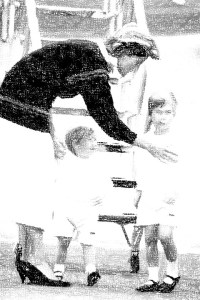
Image Credit: Public Domain / Source Unknown

Princess Diana believed that actions speak louder than words and led by example in her interactions with her children. She taught them kindness, compassion, and empathy through her own actions. How did the Princess do that? By bringing them along with her as she performed her royal duties. So, in 1993, Prince William, then 9 months, accompanied his parents on their trip to Australia and New Zealand. This action set a precedent; since then, Prince William and Prince Harry have had their own children on business trips. Quite a bit different from the mothering of Queen Elizabeth.

In the recent Forbes article, by Maura Thomas, What Does Work-Life Balance Even Mean? “To some, work-life balance means the convenience of managing a personal life during the workday without the hassle of getting permission or explaining our activities to others. Another common definition of work-life balance is equal time or priority to personal and professional activities.'” Whichever way you look at the work-life balance issue, Princess Diana was a true trailblazer in this regard. Years later, the monarchy was finally endorsing the concept of work-life balance.

Reflecting on my mothering skills and leading by example, I think of the early days of my professional career and as a young mother. I worked in academia, and my job required me to be there for extra hours to entertain recruiters searching for new hires. Early on, I brought my son to work occasionally. I also worked at home one or two days per week. My direct report understood the importance of work-life balance. And I was grateful for his flexibility at a time when remote working was rare. In life, we have to balance work and our family, especially in jobs where time is demanded.

My other lead-by-example was in spirituality, thanks to my dad. Growing up, my dad was a big proponent of “going to church.” Sundays were the week’s highlight for us as a family, although my dad would sing in the choir, and I would sit in church with my mother. I think for my dad, it was the fact that his family went to church together. We arrived together, and we left together. I also think he was trying to be obedient to God. Train your child up in the Lord.

I saw it much more as a spiritual thing for me and my kids. Not so much as an obedience to God thing. It was vital for me to expose my children to faith. A religion where God created the universe. God is love. And God can bring comfort to you when you need it. My lead by example was my unwavering faith. Faith in God. Faith in marriage. Faith in myself. Faith in my children.

I and Thou: Pray for Renewal

Whatever your faith is, how satisfied are you with the relationships in your life? And what about those you have with the people you love? Or what about the relationships that are taking a sabbatical? How do we get these relationships back on track? It starts with YOU.

Image Source: Unknown

Could you use an uplifting word?
An abundant blessing?
A word of affirmation? 
A word of kindness?
A word of grace?

YES!

What would it look like if we ALL prayed (or lifted us up to the Universe) each day for the next 40 days for RENEWAL? I could use some renewal – how about you?

PRAYER

O Mighty Creator of our Universe,

Touch us with your loving hand.
Show us how to give grace.
Fill us with your abundant love.
Renew each one of us.
So, we can transform our relationships,
Through the renewal of OURselves.

Amen

ASH WEDNESDAY

TODAY is Ash Wednesday, the first day of Lent for those of the Christian Faith.

According to LearnReligions.com:

Lent is the Christian season of spiritual preparation before Easter. In Western churches, it begins on Ash Wednesday. During Lent, many Christians observe a period of fasting, repentance, moderation, self-denial, and spiritual discipline. The purpose of the Lenten season is to set aside time for reflection on Jesus Christ —to consider his suffering and his sacrifice, his life, death, burial, and resurrection.

I and Thou: Hear Ye, Hear Ye!

Hear Ye! Hear Ye!

Can you hear them? The bells are ringing. The town crier is making the announcement.

Can you see them? The stars are brightly shining. The shepherds see them in the sky.

Can you smell it? The hay in the manager. The sheep are lying quietly, heads bowed low.

Can you taste it? The cool, damp air of the night. The child swaddled for warmth.

Rejoice!

Sing praises to the newborn King!

The sacredness of Christmas reaches near and far. The stars twinkle in the sky. The gifts of gold, frankincense, and myrrh.

Hear ye!

Hear ye!

Christ is born!

MERRY CHRISTMAS!

Image Credit: Nativity backdrop at Mybackdrop dot co dot uk