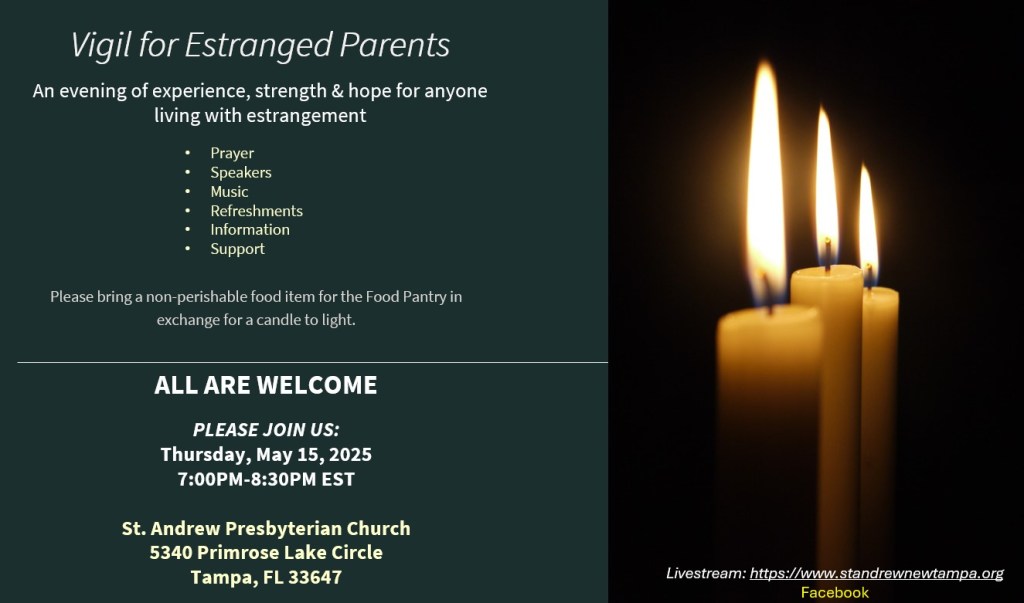
This event will be live-streamed for those who are unable to attend in-person. If attending in-person, SpringHill Suites Hotel on Primrose Lake Circle, Tampa is within walking distance. Here is the link to register:
This event will be live-streamed for those who are unable to attend in-person. If attending in-person, SpringHill Suites Hotel on Primrose Lake Circle, Tampa is within walking distance. Here is the link to register:

#NationalReconciliationDay #CallHome #Communicate #PersonalGrowth #Introspection #RespectPerspectives #LoveWins

The Freedom to Return Home
A baby bird in a cage, like an infant in a crib.
Tweets, hops, and flutters, but cannot fly away.
Sits on a perch, swings, back and forth.
Days turn to weeks, weeks flow into months.
Months become years, contemplating direction.
Quick. Smart. Wise.
The cage door opens and opportunity knocks,
Whispering softly, “Come out, come out.”
Independence calls, leaping out in joy,
“Go, find your destiny, not by happenstance.”
Genetics. Nature. Nurture. Self.
There is a hesitation.
Contemplating what lies ahead.
The cage door opens and out flies an eagle.
Tall. Slender. Piercing eyes. Determined.
Solo flight amid internal turmoil.
Triumphantly soaring above the trees.
Heart. Stops. Instantly. Tick. Tock. Tick. Tock.
Circumstances warrant rebirth.
Chirping. Singing. Flapping. Swinging. Transforming. Courage.
Homecoming.
Reflections, Poems, & Prayers on ESTRANGEMENT by Nadia Crane has recently been released. This book describes the 8 Stages of Estrangement and more. The author does a great job of simplifying the painful process of estrangement. Ms. Crane offers inspirational reflections, prayers, and poems after the reader becomes intimately personal with the topic. She then goes on to provide a crash course in it with, Estrangement 101.

This book outlines the 8 Stages of Estrangement, as Elizabeth Kubler-Ross describes the grief process related to death in her well-known 5 Stages of Grief. Grief and estrangement overlap in three of the five stages of grief. They are denial, anger, and acceptance. In Ms. Crane’s analysis, her 8 stages add another layer of acceptance, and includes rejection, shame and blame, fear, and healing.
Let’s bring more awareness of this ever-growing epidemic of broken relationships to the masses. If you know a parent who has been shunned, abandoned, blocked or has had no contact with their child, please bring this resource to their attention. If you know someone who is not speaking to their parent for other than abusive, addictive, or other harmful behaviors, please encourage them to reach out to their parent. A parent and child can reconnect with deep compassion, respect, and understanding. Order today and take the first step toward a deeper understanding of this exploding topic.
Wishing families healthy connections!
For more information visit: http://www.iandthoureflections.com
#estrangement #alienation #estrangementepidemic #estrangementbook #estrangementfromparents #estrangementdefinition
The 8 Stages of Estrangement
Looking at Both Sides of a Coin
Reconciliation
The eighth stage of estrangement, healing, is essential to the journey toward reconciliation. Below lies the conclusion of April’s Stress Awareness series focusing on the rapidly growing estrangement phenomenon. Estrangement is a painful experience that can profoundly affect both parents and children. Extended family members also experience loss. Loss of the family as it was. It can be a challenging process requiring great strength and courage for all involved. In this blog post, hope for reconciliation will be explored.
From a Parent’s Perspective
As a parent, the healing process can be a daunting task. The feelings of rejection and hurt can be overwhelming, and it can be challenging to find a way forward. It is not easy to come to terms with the fact that your child has distanced themselves from you.
The healing process for parents involves accepting responsibility for their actions and behaviors that may have contributed to the estrangement. It is essential to take the time to reflect on the past and identify areas where improvements can be made. This can include examining communication patterns, recognizing where boundaries were crossed, and acknowledging past hurt.
As a parent, it is crucial to approach reconciliation with an open mind and a willingness to listen. Valuing the child’s feelings and taking their concerns seriously is essential. It is necessary for rebuilding trust and repairing relationships.
It is also essential to seek support during reconciliation. This can involve therapy, counseling, or joining support groups for parents of estranged children. Talking to others who have been through similar experiences can help gain perspective and find strategies for a smoother reconnection process.
From a Child’s Perspective
From the child’s perspective, the healing process can be equally challenging. It is not easy to come to terms with the fact that you have distanced yourself from your parent. It can be tough to navigate the complex emotions of estrangement, such as anger, guilt, and sadness.
Healing involves accepting the past and moving toward forgiveness. This process can be complex, particularly if significant hurt and pain occur. It is essential to recognize that forgiveness does not mean forgetting or excusing past behaviors but rather letting go of anger and resentment.
It is vital to approach these conversations with empathy and understanding, recognizing that the healing process is a two-way street. It is also essential for the child to communicate their needs and boundaries clearly. This can involve setting limits on communication or establishing clear expectations for future interactions.
Seeking support during reconciliation is also crucial for the child. This can involve therapy, counseling, or joining support groups for individuals who have experienced estrangement. Talking to others who have been through similar experiences can help gain perspective and find strategies for more effective reunification.
Conclusion

In conclusion, healing is a vital part of the journey toward reconciliation. Reconciliation is not possible without healing. Open wounds, fester. Injuries that have healed leave scars. Therefore, both parties must approach the reconnection with grace, love, and patience. Reunification requires parents and children to accept responsibility, communicate their needs and boundaries, and seek third-party support. Reconciliation is challenging, but with patience, understanding, and empathy, it is possible to rebuild relationships and find a way forward for the child’s and parent’s sake and the family system. Dedication, effort, and mutual understanding can rebuild relationships and create a strong foundation for a loving and healthy family dynamic. Ultimately, the journey toward reconciliation can lead to a brighter future for both parents and children.
#Estrangement #NadiaCraneAuthor #8StagesofEstrangement #Reconciliation
The 8 Stages of Estrangement
Looking at Both Sides of a Coin
From a Parent’s Perspective
Stage 8 | Healing
Healing comes in all sizes and shapes, and moving forward with life and becoming unstuck, is essential. Healing can begin with writing, therapy, exercise, or workshops. Breathing retreats can help. Seminars on Living a Miraculous Life can help. Spiritual vacations can help. Here is where hope may enter the picture. This is to be considered cautiously. Not necessarily hope for reconciliation, although that may very well occur. It is hope for what the future might hold. Hope may also be a necessary component for coping. Parents cope in different ways. Whatever helps heal a parent from estrangement is worth doing. It is essential to heal “enough” so that life can move forward. To become “unstuck.” To start living again with purpose and with thinking differently.
I am finally able to speak about the estrangement without breaking down. I am making progress! I am spending time with the people who want me in their lives. I’m concentrating on my extended family. I have a lot of love to give, and I am so grateful I can share my love with those who see the value in me.
A parent’s perspective
This is the phase where a parent will practice self-control and where self-empowerment begins to flourish. Parents may start their day with a meaningful mantra, prayer, or other mindful practice. It is a time to try new hobbies, activities and new circles of friends. Expanding horizons and being open to conversations will start to occur. No matter how healing occurs, there is nothing more important than for a parent to be their best authentic self.
It is the author’s opinion that complete healing of oneself is not possible. Hearts will begin to mend when forgiveness occurs because it is part of the healing process.
Forgiveness of parents.
Forgiveness of personal trauma.
Forgiveness of children’s behavior.
Forgiveness of the who’s, what’s, and why’s of the estrangement.
Complete healing is impossible. So, what is next? Healing as best as possible so one can appreciate the simple joys of life.

From a Child’s Perspective
Stage 8 | Healing
This is the stage where the child accepts estrangement as part of life. The child begins to heal when they find others who have similar situations. They find a tribe that supports estrangement.
I have finally accepted that my parents are no longer my parents. As far as I am concerned, I have no parents. My friends’ parents are much more respectful, accepting, tolerant, and kind. They do not have high expectations nor drone on and on about the past. My friends’ parents are drama free, and I like that.
A child’s perspective
The beginning of this stage is very vulnerable for children. They are at a tittering juncture, wondering if they made the right choice. There is deep reflection, and they question their original thinking. This is when about 20% of estranged children reach out to reconcile with their parents. Those who accept their circumstances or what they are might seek further counseling for their healing journey.
It is the author’s opinion that complete healing of oneself is not possible. Hearts will begin to mend when forgiveness occurs because it is part of the healing process.
Forgiveness of parents.
Forgiveness of parent’s trauma.
Forgiveness of parent’s behavior.
Forgiveness of the who’s, what’s, and why’s of the estrangement.
Complete healing is impossible. So, what is next? Healing as best as possible so one can appreciate the simple joys of life.
Author’s Note: Estrangement caused me to feel unloved, and I knew I needed to love and respect myself before I could love others again. From my experience in participating in support groups with other estranged parents, there is a choice to make. You can choose to blame, distrust, and be bitter. Or, you can choose to love and heal yourself, from this incredibly harrowing experience, by opening up to others. It’s up to you. A special thank you to Kathryn Kollowa, EdD, MSN, RN, for her feedback and added insights incorporated in this most recent update.
If you gained insight into estrangement, please Share, Like, Follow or Comment.
Thank you for your support!
#Estrangement #NadiaCraneAuthor #8StagesofEstrangement #Healing
The 8 Stages of Estrangement
Looking at Both Sides of a Coin
From a Parent’s Perspective
Stage 7 | Fear
This stage involves non-estranged children. It is the fear and anticipation of potential estrangement from another child. After estrangement, fear clouds the relationship between a parent and the non-estranged child. This fear negatively influences parenting decisions. A parent will discipline the non-estranged child less frequently. A parent will adjust their communication for fear that something said will trigger the non-estranged child to estrange. Is the fear realistic? For a parent who has lost a valued relationship with one child – the fear is real – it is a perceived danger and potential threat. The risk of losing another family connection is constantly lurking in the subconscious. The relationship is fragile, and a parent wants to guard it to ensure it does not break. Respecting adult children and their choices is vital for a healthy relationship.
I fear that my other son will stop speaking to me too. I realize this is irrational, yet the thought sneaks into my mind every day. I find the fear paralyzing at times.
A parent’s perspective
Living and parenting with the fear of another estrangement is overwhelming. It is a difficult stage to endure, and learning to live day-by-day keeps worries at bay and is a worthy goal. As the non-estranged child matures, the fear of estrangement may dissipate based on their behaviors and communication. Furthermore, this fear extends to all future relationships as well. Remember this when meeting, introducing, and welcoming others.

Stage 7 | Acceptance Part 2
Children at this stage have accepted estrangement as a way of life. They realize that time has passed, and they and the estranged parent have become different people. If the child has undergone therapy or is questioning their role in the estrangement, they may consider reconnecting. Children at this step are curious. They are interested to know whether what others tell them is true. They meet other people and begin to realize that every family is flawed. All families have struggles.
I wonder what my mother thinks of me. I wonder if she even cares. When I was growing up it seemed that she only cared about herself. I have done a lot of inward work and I might want to reach out one day and see how my mother is. But for now, I like my life just the way it is right now.
A child’s perspective
This stage requires the child to do the necessary emotional work that needs to be done. Children realize they are not the same people they were at the initial point of estrangement and recognize that their parents may have also grown and matured into a person they just might want to engage with. As maturation progresses, they may feel a void. They may have exasperated an issue. They begin to accept themselves for who they are and who they have become.
#Estrangement #NadiaCraneAuthor #8StagesofEstrangement #Fear #Acceptance
The 8 Stages of Estrangement
Looking at Both Sides of a Coin
From the Parent’s Perspective
Stage 6 | Acceptance Part II
Once the anger has dissipated, a parent can start the next phase of Acceptance Part 2. Parents may consider self-help activities such as journaling, painting, or meditation at this stage. To begin this part of the journey, parents need to reflect. Reflect on their relationship with the estranged child, as well as on their own childhood relationship with their parents. A note of caution for this stage. Reflection can be emotionally draining. So, be aware of what is happening physically. Check breathing, heart rate, and sweating. Pay attention to the body’s physical reactions. Stop or take a break from reflecting when it feels uncomfortable.
After years of feeling unheard, I joined a support group for Estranged Parents. It really helped me in so many ways. I can now accept the estrangement for what it is and not blame myself anymore. This is something my child initiated and only they can change it. I am open to reconciliation. I am hopeful that one day my child will see how much I have grown to accept and respect decisions. I don’t have to agree. I just have to accept. It is so sad to know that estrangement has exploded in recent years; yet it brings a sense of relief – that I am not alone in this nightmare.
A parent’s perspective
In this stage, a parent accepts the estrangement as part of a bigger picture whereby a child may not have estranged willingly. Or thoughtfully. Or knowingly that the estrangement would last for months, years, or decades. During this phase, the parent reflects on the hidden pain and/or trauma the child may have had or perceived they had. The Acceptance Stage also acknowledges that a child may not know how to reconcile. It is the phase where compassion for the estranged child and their pain begins.
Moreover, this step comes to terms with a child making “no contact” and respecting the decision. This stage is a promising one. Once a parent has accepted the estrangement as part of life’s circumstances, a parent can start to let go of the past and realize that there may be no future with an estranged child. A parent should no longer attempt to mail letters, send friend requests, and ask others who may know the child for any information. Parents need to use their judgment. There is a no one size fits all. It might be okay if a parent wishes to send a birthday greeting each year. It is the realization of the reason behind the action. Is the action for the parent? Or, for the child, in an attempt to invade their privacy or expect a response?
This stage is challenging, especially for hopeful and generally optimistic people. Thinking that reconciliation may happen someday conjures up visions of unicorns and torture. The goal of Acceptance Part 2 is peace and respect for oneself and others, including an estranged child. Some parents may call this radical acceptance. Furthermore, it is the process of stepping back from the estrangement and finally moving forward with life and having a purpose.

From the Child’s Perspective
Stage 6 | Fear
Fear is the stage when the child begins to mature and change. They fear the unknown. They fear getting to know themselves. They fear having made bad decisions. They fear their parent has disowned them. Or the parent no longer wishes them to be a part of their life. In this stage, children fear the other parent or anyone who has aided in the estrangement. What will that parent do if the child reaches out and attempts a reconciliation? It is common in this stage to question the motives. The child has felt manipulated in the past and fears feeling manipulated again.
My aunt sent me an email with the subject: Your Parents. When I clicked in, there was nothing. Something must have gone wrong technically. I googled my parents’ names and obituary, and nothing came up. I concluded that my aunt was trying to manipulate me into getting back into contact with my parents. I blocked her name on my email, and now I won’t have to fear any more emails again.
A child’s perspective
Older adult children drop out of a parental relationship to avoid unwanted input. Some of these adult children estrange from their parents to protect their children. Adult children fear their parents, and they fear becoming like their parents with their own children. Hence, the reason for cutting the parents out of their lives. For mentally weak-minded people, it takes a lot less energy with a smaller circle of friends and relatives.
Author’s Note: Estrangement caused me to feel unloved, and I knew I needed to love myself before I could love others again. From my experience in participating in support groups with other estranged parents, there is a choice to make. You can choose to blame, distrust, and be bitter. Or, you can choose to love and heal yourself, from this incredibly harrowing experience, by opening up to others. It’s up to you. A special thank you to Kathryn Kollowa, EdD, MSN, RN, for her feedback and added insights incorporated in this most recent update.
If you gained insight into estrangement, please like and comment.
(This is my “call to action” I’m supposed to include in every post and often forget.)
Thanks so much for your support!
#Estrangement #NadiaCraneAuthor #8StagesofEstrangement #Acceptance #Fear
The 8 Stages of Estrangement
Looking at Both Sides of a Coin
From a Parent’s Perspective
Stage 5 | Anger
Anger is the reaction to an unpleasant situation. It is a normal emotion and frequently occurs in the everydayness of life. The anger resulting from estrangement runs deep – much more profound than the everyday kind. This one is the ugly cousin of shame and blame. This anger is volatile, yet, it can also be quietly simmering beneath the surface, waiting to explode.
During the estrangement process, anger is necessary. It is anger with oneself, a child, a spouse or former spouse, family, friends, and even God. Anger that questions the estrangement and the role others may or may not have played to either lead to the estrangement or to support and encourage it. Did a parent do all they could do to prevent this? Did a spouse (or former spouse) encourage counseling? Did family members disown the estranged parent or intervene? Was there a feeling of hopelessness? Or did you not do enough or do too much?
Could have, should have, would have. Just maybe I could have done something to have stopped this estrangement. I ask myself how could a father encourage their child to stop speaking to their mother? I am so angry, my blood is boiling. Then, there are the grandparents and aunts and uncles who no longer are “allowed” to speak to me. It is a hot mess. I am bearing the pain. All by myself. It is unbearable.
A mother’s perspective
The Anger stage can include a loss of purpose in life. A parent may feel hopeless and helpless. Even though thoughts of murder, suicide, and kidnapping may occur, one cannot act upon them. Life is worth living; don’t give up. This anger phase involves questioning oneself and others, which is necessary for healing. It is vital to vent by deep breathing, talking to a therapist or friend, exercising, or alleviating the stress that builds from the anger during this anger stage.

From a Child’s Perspective
Stage 5 | Denial/Rationalization
At this stage, another person may be encouraging the estrangement and wish it to continue. A spouse or a close friend. Someone who wants to destroy the original relationship for their own gain or power and control.
Life is so busy right now. I have two little kids who demand my time and energy. I have no energy left to deal with my parents. My wife believes my parents are toxic. It is troubling to me; yet I want to make her happy. Honestly, I can take or leave my parents. I follow my wife’s lead.
A child’s perspective
Individuals in this stage fight their emotions and natural instincts to reconnect. Repetitive messages remind them that this course of action is the best. Reconnecting with the person they are estranged from would open up past wounds and be futile. Their minds try to convince them they are on the right path. Keeping their parent out of their life will be better for them. This is a precarious stage. If an unforeseen situation occurs or an unplanned crossing of paths by either a neutral or estranged person, reconnection is possible.
Author’s Note: Estrangement caused me to feel unloved, and I knew I needed to love myself before I could love others again. From my experience in participating in support groups with other estranged parents, there is a choice to make. You can choose to blame, distrust, and be bitter. Or, you can choose to love and heal yourself, from this incredibly harrowing experience, by opening up to others. It’s up to you. A special thank you to Kathryn Kollowa, EdD, MSN, RN for her feedback and added insights incorporated in this most recent update.
If you gained insight into estrangement, please
Share, Like, Follow or Comment.
Thanks so much for your support!
#Estrangement #NadiaCraneAuthor #8StagesofEstrangement #Anger #Denial #Rationalization
The 8 Stages of Estrangement
Looking at Both Sides of the Coin
From the Parent’s Perspective
Stage 4 | Shame & Blame
Shame typically begins during the rejection phase after a parent has worked through Acceptance Part 1. The reality of the estrangement starts to set in. The questioning begins. A parent may think they lack parenting skills. What on earth did a parent do for a child to shut a parent out completely? Or, what did a parent not do? This stage is when a parent internalizes the pain and questions the validity of the source. Frequently, a parent does not know the reason(s) for the estrangement. A parent begins to feel shame. The shame of a child’s rejection and the shame of what behavior a parent may have or may not have done or said or not said. The mere thought of a child rejecting a parent is vile; therefore, a parent experiences shame. A deep to-the-core type of shame.
I rack my brain day and night trying to figure out where I went wrong. I thought I was encouraging and supportive. I had heart-to-heart conversations with my child when he was young. As he aged, he started to distant himself from me. I thought it was a normal part of growing up. The shame and blame messages played again and again every day and every night. Many nights I cried myself to sleep. When will this nightmare end?
A parent’s perspective
Shame and blame often coincide. A parent blames themself. A parent blames the child. A parent blames the spouse (or former spouse). Or, in the case of parent alienation, blames the court system. In the end, the question remains, was the estrangement caused by another human being? Or was the estrangement caused by an action? A miscommunication? A series of misfortunate incidents? Lack of communication? Or no communication at all? There is blame, shame, and anger all around.

From a Child’s Perspective
Stage 4 | Acceptance Part 1
The child comes to terms with the fact they can no longer reach out to the parent under any circumstances. This is when the child begins to accept that they are not speaking to a parent. They have distanced them from the parent and continue not responding to attempts at contact. They have made a choice, and nothing will set them off course. They see this conflict or relationship avoidance as black and white. There is no in-between thinking for the child.
I chose to dissolve this relationship because it wasn’t working. My whole life was turned upside down and I don’t need my mother causing any more drama. It was all about her. She would instigate fights with my father, and I got caught in the middle – all the time. I’m done. No more drama. My father and I have gotten much closer since we are on the same team.
A child’s perspective
We won. My mother lost.
At this point, the child is telling themselves they no longer have the parent they have estranged from. They have cut them out of their life. The pain they feel is pushed deep inside and locked in a vault. This stage is when the child feels proud of themselves – that they actually have separated from the parent. The parent who is the perceived enemy is no longer valued, recognized, or seen as a threat. As far as the child is concerned, the parent no longer exists. The child has accepted this course of action and is determined to live their life without their parent in it.
Author’s Note: Estrangement caused me to feel unloved, and I knew I needed to love myself before I could love others again. From my experience in participating in support groups with other estranged parents, there is a choice to make. You can choose to blame, distrust, and be bitter. Or, you can choose to love and heal yourself, from this incredibly harrowing experience, by opening up to others. It’s up to you. A special thank you to Kathryn Kollowa, EdD, MSN, RN for her feedback and added insights incorporated in this most recent update.
If you gained insight into estrangement, please like and comment.
(This is my “call to action” I’m supposed to include in every post and often forget.)
Thanks so much for your support!
#Estrangement #NadiaCraneAuthor #8StagesofEstrangement #Shame #Blame #Acceptance
 I and Thou Reflections