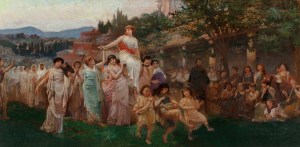
June Weddings – Part 4: The Christianization of Roman Wedding Traditions

Ah! June!

It is a lovely month, don’t you think?

A time to connect the dots between Ancient Rome and our modern-day wedding ceremony.

In parts 1-2, we saw how the goddess Juno influenced weddings in Ancient Rome. Part 3 discussed the faith shift from multiple gods to a single triune God.

Here, we will hear the echos of Juno, which are still heard across wedding venues near and far.

Blending of Traditions

Christianity reinterpreted or replaced many of the ancient wedding traditions. Let’s look at a few.

Sanctification of Marriage

The early Christian Church viewed marriage as a sacred covenant. For new Christians, the sacred covenant transitioned from Juno to God. Wedding ceremonies included Christian prayers, blessings, and the presence of clergy.

June Weddings

In Part 1, we learned how the calendar month of June derived from Juno. Hence, it was a favorite month to marry. The Church continued this tradition and endorsed June weddings.

Wedding Attendants

The role of the “pronuba” paved the way for bridesmaids and groomsmen. Wedding attendants were and still are supportive figures for the bride and groom. Just like the ancient pronuba. This tradition is an example of how an ancient tradition was redefined. It morphed into the tradition of involving close friends and family in the ceremony.

An elaborate gold and onyx Roman wedding ring from the 3rd century. (Argyor)
Image Source: ancientorigins dot net

Wedding Rings

Wedding rings date back to the Egyptians, 3000 BC. Even then, rings symbolized eternal love and commitment, but not in the way they are today.

The Romans continued the tradition of the wedding ring. But the groom often gave the ring to the bride’s father, as it served as a sign of a bride purchase. 

By the second century BC, the bride was given a gold ring to indicate the groom’s trust in her as his property. In ancient Rome, brides were given two rings. One was gold. The other iron. The gold ring was worn for social engagements, and the iron ring was worn at home.

Bridal Veil

The bride’s veil, however, had a deeper, darker meaning. It was designed to ward off evil spirits. Today, the modern-day bride can choose to wear one or none. The veil came to be a covering to prevent the groom from seeing the bride until the exchange of vows.

The Wedding Cake

Over the years, the spelt cake eaten during the wedding ceremony gradually became one of the highlights of the modern-day wedding reception. Namely, the wedding cake. Most brides and grooms feed each other a piece of cake in front of family and friends. Did you know this tradition started in Ancient Rome?

Part 5 will wrap up this series. We will discover more themes linking ancient customs to contemporary weddings.

#Marriage, #June, #Juno, #Weddings, #Tradition, #Christianity, #AncientRome

June Weddings – Part 3: Transformation to Christianity

Ah! June!

It is a lovely month, don’t you think?

And a time to think about love. The love of friends. The love of God.

In Part 1, we explored Juno, the goddess of marriage, and her central role in wedding ceremonies. Part 2 peeked at ancient wedding traditions. During the ceremony, we learned the significance of the bride and groom eating spelt cake. And, of course, the significant role of “Pronubas” in keeping tradition.

Part 3 will discuss the shift of faith in the Roman Empire and its effect on Juno and other gods.

From Multiple Visible Gods to One Invisible Triune God

Christianity swept through the Roman Empire. It became the official religion in 380 AD. This transformation reshaped beliefs and practices.

The Spread of Christianity (Map 300-600 AD)
Image Source: orthodoxchristianity.net

Imagine the upheaval, the confusion, and the uncertainty. An entire religious and spiritual system was being upended and replaced by a new faith. Ancient Rome, a pluralistic region, converted to Christianity seemingly overnight. From worshipping many gods and goddesses to the belief in one invisible triune God.

Hardworking citizens who had crafted small household gods were now rendered obsolete. Picture the uproar, the disbelief, and the resistance of business owners. The society they once knew was shifting its core beliefs right before their eyes. The worshipping of statues became a mere admiration and, in some cases, a symbol of power.

An Omniscient God

Faith took a new form.

Time and space limited existence.

But not God.

God, now unseen and untouched, defied the constraints of time and space.

Imagine a circle without a beginning or an end. Then, think of God. Try to visualize God as an all-encompassing circle. God is the beginning and the end. And everywhere in between. Not only the creator of the universe but a divine being who lives within each of us. This new God couldn’t be seen or touched. Yet, some were touched by God and were never the same.

It must have been mind-boggling for ancient Rome to undergo such a transition.

In the next post, we will look at the Christianization of Roman Wedding Traditions. Join us in Part 4 as we unravel the threads connecting Juno to the vows we still exchange in today’s modern world.

#June, #Juno, #Weddings, #Traditions, #Roman Empire, #Christianity

June Weddings – Part 2: Ancient Traditions

Ah! June!

It is a lovely month, don’t you think?

And perhaps a magical time for a bride and groom to pledge their love to one another amongst family and friends.

In Part 1, we talked about June, which dates back to the Roman Empire and how Juno, the Roman goddess of marriage and childbirth, inspired its popularity among couples wanting to tie the knot.

In this post, we will dig deeper into the role Juno played in the traditional ancient wedding.

Ancient Wedding Traditions

Image Credit: Public Domain – A Roman Wedding Procession by Edwine Howland Blashfield

Roman weddings, like those of the affluent of our day, were elaborate ceremonies with religious rituals. They centered around worshipping Juno, the goddess of marriage. The bride and groom did so in order to receive a blessing from Juno for their marriage. This included sacrifices, prayers, and customs thought to cement the couple’s future and to bring happiness and prosperity.

Let’s look at specific examples.

Choosing the Wedding Date

June was the most popular month for Roman weddings. And Juno had a lot to do with that. Even so, brides and grooms could consider other months as well. But they were always based on lunar cycles.

The Confarreatio Ceremony

The most sacred Roman wedding was called the “confarreatio.” A significant part of this ritual involved the couple sharing a spelt cake (panis farreus). The cake symbolized unity and abundance. It was a solemn pledge to Juno and to each other.

Nuptial Rites and Sacrifices

Before the wedding ceremony, the couple offered cakes, wine, and incense to Juno while the Priests recited prayers. These practices further emphasized Juno’s central role in the wedding ceremony. These offerings were believed to purify and bless the union.

The Bridal Procession

After the ceremony, a procession would lead the bride to her new home, where nuts and coins lined the path. These symbolized fertility and prosperity. As the procession made its way through town, they stopped at shrines and offered prayers to Juno. Further confirming Juno’s protection over the marriage.

The Pronuba

Like the modern-day maid or matron of honor, the “pronuba” was a married woman. The pronuba assisted the bride before, during, and after the wedding ceremony. As a representative of Juno’s, she embodied the ideals of marital fidelity and longevity. Her role was to guide the bride through the wedding rituals. It was no wonder that the pronuba ensured tradition was followed.

Legacy of Time

There is no doubt that the goddess Juno played a pivotal role in ancient wedding ceremonies. It underscored the profound cultural significance and importance of marriage in Roman society. Such customs highlighted how entwined Juno was in the institution of marriage.

Part 3 will explore the transformation from Juno’s central role in the wedding ceremony to the sacred vows before the God of Christianity.

#Love #June #Juno #Weddings #Traditions

June Weddings – Part 1: The Origin

Ah! June!

It is a lovely month, don’t you think?

And a favorite time to get married – at least, in 2015.

Fast-forward to 2023, and June falls to number three, according to a recent post on Brides.com. For the curious-minded, October was number one, followed by September.

Credit: Illustration of the Roman goddess Juno by Samantha C. George

Juno? Who was Juno?

June is also the month named for Juno, one the Romans most popular goddesses.

Over the next few blog posts, we will learn how Juno influenced the modern-day wedding. But first, we start with how “June” became the sixth month of the calendar we still use today.

The Month of June

So, how did “June” become the sixth month of our calendar?

June is named after the Roman goddess Juno, the god of marriage and childbirth. She was the wife of Jupiter, the king of the gods.

June, the sixth month of the Julian calendar, was introduced by Julius Caesar in 46 BCE. It was on this date that June’s 29 days changed to 30 days, as per timeanddate.com.

Juno: The Goddess of Marriage

In Roman mythology, Juno was the queen of the gods and the protector of women and marriage. Her Greek counterpart was Hera.

Juno oversaw all aspects of women’s lives, from birth to marriage and family. As the goddess of marriage, Juno blessed and protected couples. So, those seeking her blessing did so to gain favor amongst the gods so that their marriages would have a higher probability of working out.

The popularity of June weddings dates back to ancient Rome. Marrying in June was believed to honor Juno. Which is why couples leaned toward June. After all, they thought that Juno brought harmony and prosperity to the marriage.

Legacy of Time

June weddings are a testament to the legacy of these ancient beliefs. Even though many modern-day couples choose to marry in June, they may not realize they’re following a tradition that dates back millennia.

In Part 2 of this series, we will continue to explore how Juno influenced the modern-day wedding.

#June #Juno #Weddings #Traditions

The Legacy of a Good Father

Father’s Day

is a time to honor and celebrate the fathers in our lives. While expectations of fathers may have changed over the years, the core values of what makes a good father (or step-father) are timeless.

A good father is more than just a provider; he is a nurturer, a guide, and a pillar of support for his partner, children, and community.

Core Values of a Good Father

Attachment

Attachment theory, developed by psychologist John Bowlby, emphasizes the importance of forming a secure bond between a child and their caregiver. A good father fosters this bond through consistent presence and emotional availability. He helps his children develop a sense of security and trust by providing comfort and support. It starts with taking turns with changing diapers, late-night feedings, and going to bed routines. This secure attachment lays the foundation for healthy emotional development and relationships throughout the child’s life.

Attunement

Attunement refers to a parent’s ability to recognize, understand, and respond appropriately to their child’s emotional states. A good father is attuned to his children’s spoken and unspoken needs. He listens actively, observes carefully, and provides support to help them navigate their feelings. A good father is empathetic and helps his children feel understood and valued, fostering their emotional intelligence and resilience.

Respect

Respect is fundamental to any healthy relationship, and the father-child relationship is no exception. A good father respects his children’s individuality and encourages their autonomy. He acknowledges their unique personalities, interests, and perspectives and supports their independence. By showing respect, he teaches his children to value themselves and others, promoting a healthy sense of self-worth and mutual respect in their interactions.

Personal Growth

A good father is not only a teacher but also a learner. He models personal growth by adapting to his family’s changing needs. Whether deepening emotional intimacy with his spouse, enhancing parenting skills, or working on personal challenges, his commitment to growth inspires his children to pursue their own development paths. This lifelong learning mindset fosters a culture of continuous improvement and resilience within the family.

Prioritizing Children’s Needs

One of the defining qualities of a good father is his ability to prioritize his children’s needs. This does not mean neglecting his own well-being but instead finding a balance where the children’s physical, emotional, and psychological needs are prioritized. A good father understands the importance of providing a safe and nurturing environment, even if it requires personal sacrifices. He makes sure they have the resources and support they need to thrive.

Mental Health

A good father values good mental health. He recognizes the importance of emotional well-being and openly discusses such things. By addressing issues such as respect, value, self-esteem, stress, anxiety, and depression, he helps normalize the conversation. Providing space for emotional expression and seeking professional help promotes a healthy, balanced life.

Respect for the Mother of His Children

A good father shows respect for the mother of his children. He recognizes that a harmonious and respectful relationship sets a positive example for their children. Whether partners or co-parents, mutual respect and cooperation are crucial for creating a stable and loving environment. By treating the mother of his children with kindness, consideration, and respect, he demonstrates the importance of healthy relationships and teamwork. This respect benefits the children by providing a model of positive interaction that strengthens the overall family unit.

The Legacy of a Good Father

Father’s Day is an opportunity to reflect on and appreciate the profound impact that good fathers have on their children’s lives. Good fathers lay a solid foundation. As we celebrate this special day, let us honor the fathers who embody these qualities and strive to be the best role models they can be. Their dedication and love create a lasting legacy for generations to come.

Happy Father’s Day

#Father’sDay #Attachment #Attunement #Respect #Mental Health #RoleModel

The Spirit of the Pearl

The Spirit of the Pearl

Image Credit: Publicdomainpictures

The shimmering pearl calls a name,
Come, admire its exquisite beauty,
Bathe in the glory of iridescence.

Come closer, hear whispers in your ears,
A voice that soothes anxieties and fears,
Shed inhibitions, face your demons, call them out.

The pearls of life dwell in the soul,
Conduits for relaxation and introspection,
Revealing wisdom to impart.

Emotional tides ebb and flow,
Bringing harmony, calm, and peace.
Carpe diem, seize the day’s release.

The Spirit of the Pearl refocuses the heart,
To fully appreciate what matters most,

Love and intimacy with God and others.

Filled with purity and integrity,
Pearls shed tears from heaven above,
Anointed by the cross at Calvary.

See the pearls up ahead?
Twelve gates with twelve pearls,
Each gate made of a single pearl*,
Leading to eternal life.

*(Revelation 21:21)

#Pearl #Poetry #Sacredstone # #June #Birthstone #Spirituality

The Spirit of The Emerald

In the heart of an enchanted forest,
Leaves sway in rhythmic motion.

Glimmering stars adorn the sky,
As evening echoes ancient times.

The Spirit of the Emerald stirs,
Discerning wisdom to impart.

Weary souls traveling near and far,
Guided by candles flickering aglow.

Aaron’s mighty tribal breastplate,
Wards off enemies and embraces strength.

The Spirit of the Emerald whispers,
Secrets of renewal and hope.

Emotional wounds fade away,
Mending bridges to the Divine.

Like spring’s first blooms,
Sprouting through the frost-free soil.

The Spirit of the Emerald beckons,
Radiating her rich green hue.

Come fairies, dance on moonlit beams,
Wave your wands of fairy dust.

Sprinkle healing throughout the land,
To mortal beings everywhere.

The Spirit of the Emerald commands,
The heavens and constellations listen.

Imagine magnetic fields converging,
Revealing enlightenment and purpose.

Like a million diamonds glistening,
A newfound clarity emerges.

The Emerald’s Spirit leads the way,
Mesmerized by the jasper and ruby rainbow.

Beyond the heart of the forest,
The Emerald’s Spirit bows in reverence.

To the One upon the throne in heaven,
Where love everlasting endures forever.

Image Credit: callison56 wallpapersafari.com

#Emeralds #MayBirthstone #Spirituality #EnchantedForest #Fairies

Finding the Sacredness in Tragedy – Part 8: A Time For Everything (8/8)

Image Credit:  Zaza Tepnadze found on Pinterest

We have been on a quest to find the sacredness in tragedy. A mighty tall order, wouldn’t you say?

In the previous seven posts, we looked at tragic events and took deep dive into the meaning of righteousness and sacredness. Today, we will explore trauma.

The Miracle of Birth

For those of you who have given birth, or witnessed this, it is nothing short of miraculous. The experience of birth is sacred.

Babies

Babies are incredible. They have the tiniest toes and fingers. With bodies that almost fit in the palm of a hand. And eyes that may or may not be open. Yet, in a few days, babies start to gaze into their parent’s eyes with all the love in the world. They are truly a gift from God.

Life-and-death circumstances might make us question God’s omnipotence (the power of God), or God’s goodness. In other words, God’s willingness to prevent terrible things from happening. Such as when a baby is miscarried. Or stillborn. Or born less than perfect.

Parents may wonder “Where was God?”

Or

“Why did this have to happen?” 

Surely, God doesn’t create imperfect beings. God can’t take my baby away. Can he? 

No Answers, Yet

We simply do not know. Maybe one day we will find out. But for now – for many of us – certainty is elusive.

Some of us may simply choose to trust that God is there. Some may be fortunate enough to feel God’s presence – even in the midst of suffering. While others may feel lost, or alone or even foresaken by God. During times of trial and tribulation we often experience a floodgate of emotions. We may feel that God is nowhere to be found. Yet, could it be that, even then, God is with us – even though we may not see it? Years later when we look back, we may discover that lessons have been learned, inner convinctions formed, and/or meaning found.

The next time you find yourself in the middle of a storm, can you imagine holding out your hand so God can grasp and hold it in his own?

Traumatic Events

Think back on your own life. Do you remember traumatic events from your childhood…or teenage years…or adulthood?

People often think of the big events. Yet seemingly smaller incidents can become a significant source of trauma as well. Like having best friends move away when you were a young child. Or perhaps there were times when you were bullied. Maybe you lost precious possessions such as a piece of jewelry, or had a favorite keepsake stolen from you at school. At the time, perhaps your emotions were strong or clouded your thinking. You might even have thought, “Why did God let this happen to me?”

Over time, however, we can learn from our experiences and reflect upon them. What lessons have we learned from the trauma or tragedy that we experienced? Have we become more compassionate? Have we devoted ourselves to a cause that is close to our hearts? Did you, for example, decide to become a doctor because you were once an accident-prone kid?

It may be that things happen for a reason, which, at first, we may not have understood. Maybe that is where the saying, “Time will tell,” comes from.

A Time for Everything

In life, there is death. Before death is life. Life begins at birth. Could it be that, after death there is eternal life?

There is a time for everything, and a season for every activity under the heavens: a time to be born and a time to die.

Ecclesiastes 3:1,2a

Over the past few weeks, we have explored the question: Can sacredness be found in tragedy? As we move forward in life, may we be open-minded. May we love one another through all the facets of our lives, including the tragedies that come out of nowhere.

#Birth #Time #Sacredness #WhereWasGod #Tragedy #LifeQuestions

Finding the Sacredness in Tragedy – Part 7: The Story of Bella Joy (Continued)

Image Credit: “Womb Paradise” by Alex Florschutz from sistersawake dot org

In Part 6, we learned a little about Miss Bella and her infant son who was born with a rare disease. This tragic circumstance was so unepected. No one saw it coming. We continue this story.

It’s Not Fair

After the initial shock wore off, Miss Bella may have thought:

It’s not fair to the baby.
It’s not fair to (us) the parents.
It’s not fair to (our other child) the sibling.
Life expectancy is short with this rare disease.

Why God? Why me? 

Miss Bella felt so alone after her baby’s birth. (YouTube Video*)

After all, how would we feel if we were told our baby has a rare disease? Six months later, she put on a courageous face and filmed a YouTube video. Why? Because she didn’t want others to feel alone like her.

The Story of Bella Joy shows how an apparently uneventful pregnancy can yield a calamitous life-changing outcome. Miss Bella navigated through an unexpected situation as best she could. Then, this strong momma shared her experience with the world to give others hope and encouragement. Instead of dwelling on the negative, she found the strength to overcome her circumstances.

And, more importantly, to serve others.

Why is service so important?

Serving others reflects God’s love and fulfills the Biblical commandment that we love one another. If we focus on love and serving others, even in the midst of evil or heartbreak, that is where we find the sacred. It does not nullify – or remove – evil, tragedy, and human suffering. Rather it is precisely here, in the midst of catastrophe, that the sacred becomes manifest. This is where God is present – whether we see and sense him, or not. And this is why, even in the most terrible circumstances, people are able to find hope, offer love, and serve one another.

The next post will explore the cycle of life in the context of there being a time for everything. We will then wrap this series up on finding the sacredness in tragedy.

*YouTube dot come/watch?v=3Jc2w2eAhMc&t=21s

#Birth #NeonatalMarfan #Sacredness #WhereWasGod #Tragedy #LifeQuestions

Finding the Sacredness in Tragedy – Part 6: The Story of Bella Joy

Image Source: Creative Commons (Artist Unknown)

Parts 1-5 focused on God’s love, compassion, and mercy, even amid tragedy. 

Today, we will again ponder the many questions in life, starting with birth.

For you created my inmost being; you knit me together in my mother’s womb.

Psalm 139:13

The Story of Bella Joy

Bella Joy had an uneventful pregnancy. There was nothing out of the ordinary at any point in time during her pregnancy. All the precautionary prenatal care guidelines were followed.  She even passed all the recommended tests with flying colors, including genetic testing. Still, she and her family prayed for a healthy baby.

The Eventful Delivery

Miss Bella had a delivery that went sideways. The soon-to-be mom, for the second time, had scheduled a C-section on August 3. Yet, the baby had different plans. Unexpectedly, this young woman went into spontaneous labor on August 2.

Her medical team was on board and ready to prep her for the C-section when she arrived at the hospital. Not long after, Miss Bella gave birth to a baby boy. She was on edge until she heard the sweet sound of her newborn cry. Within seconds, he did. The wail seemed to signal a healthy baby. She breathed a sigh of relief.

She remembers her doctor saying calmly, “Your baby is having difficulty breathing.” But because Miss Bella had heard the infant cry, she didn’t overthink what the doctor had said. The doctor did not sound alarmed. Nothing seemed out of the ordinary. In fact, she remembered joking with the medical staff about there being a full moon that night. 

In the meantime, five nurses and doctors were working on her baby. She didn’t realize the commotion had been about her baby. She hadn’t a clue. However, when the OR staff person wheeled her to the nursery, she sensed something was off. When she saw her husband, she knew something was dreadfully wrong. 

At that moment, she learned that an infant can cry and still not be okay. “What could it be?” She asked herself. Her ultrasounds had been normal; and her pregnancy had been uneventful. She was not prepared for what was next.

Miss Bella’s son was born with Neonatal Marfan Syndrome, a rare genetic disease. She wanted answers.

“Where was God?” “Why did this have to happen?”

In the next post, we will keep searching for answers.

#Birth #Neonatal Marfan #Sacredness #WhereWasGod #Tragedy #LifeQuestions